
Διαβάστε το άρθρο στα ελληνικά.
What buying property in Greece costs: every line, with the provision behind it
On this page
Transfer tax at 3,09% and where the 0,09 comes from, the ΦΠΑ suspension with five months left on it, the notary tariff that stepped down in 2015, the Κτηματολόγιο fee that changed in January 2026, and two purchases priced line by line.
This guide is a preliminary screen for a cost or timing question, not legal, surveying, engineering or tax advice; read the full scope and limits before relying on it.
A buyer we spoke to last spring had budgeted eight per cent over the asking price, which is the figure the internet gives. The deal was a field outside Larissa at 80.000 €. What tripped the budget was not a tax rate. It was that a survey has to be commissioned whatever the plot is worth, that the fixed parts of the notarial and registry tariffs are the same on a field as on a villa, and that the land registry's tariff had changed in January. The percentage on a cheap rural plot is higher than the percentage on a house worth four times as much.
This page prices both cases line by line, and every line names the provision or the published tariff behind it. Where a figure is what the market charges rather than what an instrument says, it is labelled. Start with the buying land in Greece checklist if you have not yet fixed which property you are pricing.
The recodification nobody announced
On 18 July 2025 Greek property taxation stopped living in a shelf of post-war statutes and became one text: ν. 5219/2025, Κώδικας Φορολογίας Περιουσίας, ΦΕΚ Α΄ 130/18.7.2025. Its own closing article puts it in force from publication. Transfer tax, formerly α.ν. 1521/1950 ratified by ν. 1587/1950, is now άρθρα 22 to 52. ΕΝΦΙΑ, formerly ν. 4223/2013, is άρθρα 8 to 17. The objective-value system, formerly άρθρο 41 ν. 1249/1982, is άρθρα 3 to 5.
Two more instruments landed on top of it inside six months, and between them they moved the new-build tax position, the annual bill on a main home and the cost of registering the deed.
Two numbers, and the one that decides the tax
Every Greek deed carries a price and a state value. The price is what you agreed. The state value, the αντικειμενική αξία (antikeimeniki axía), comes out of a formula. Άρθρο 25 ν. 5219/2025 settles which one the tax is charged on: the taxable value is fixed by άρθρα 3 to 5, and where the price in the deed is higher, «ο φόρος επιβάλλεται στη μεγαλύτερη αξία».
Read the asymmetry carefully, because it is the whole reason a bargain does not feel like one at the tax office. The objective value is a floor. Paying below it does not reduce the tax. Paying above it raises the tax to what you paid.
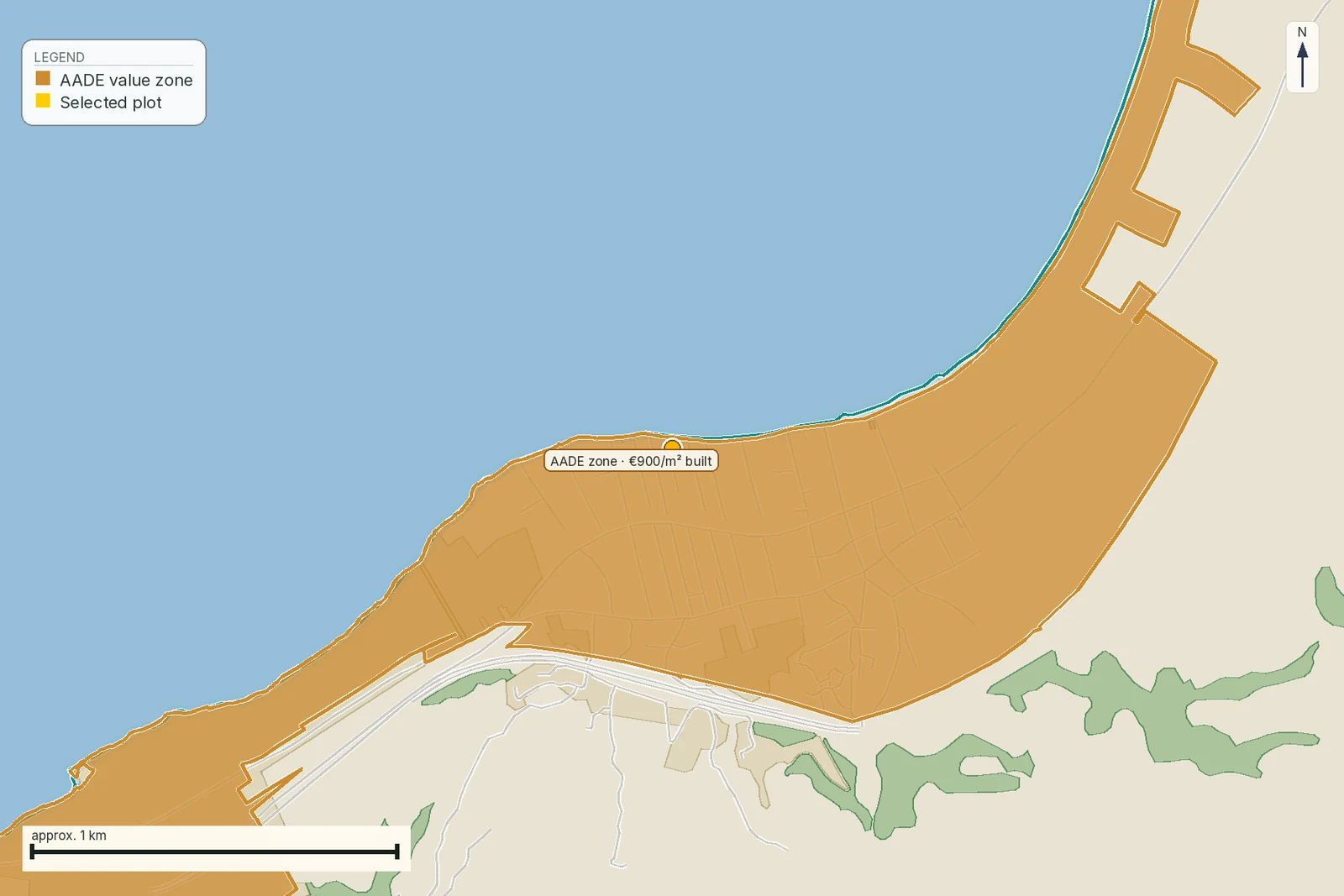
For land inside a plan or a settlement the objective value starts from a published τιμή ζώνης, a price per square metre for the valuation zone, adjusted by coefficients. The operative table is Υ.Α. 57732 ΕΞ 2021 (ΦΕΚ Β΄ 2375/7.6.2021), in force since 1 January 2022. On 1 August 2026 nothing newer has been gazetted: e-nomothesia's own αντικειμενικές αξίες index carries nothing later than ΚΥΑ 138311 ΕΞ 2024 (ΦΕΚ Β΄ 6326/15.11.2024), which moves technical points of the calculation and leaves the zone prices alone. A revision is talked about; no instrument fixes a date, and this page prices the 2021 table.
Out-of-plan land is a different mechanism, and this is the part almost no buyer's guide carries. There is no zone price over a field. The value is worked on a separate form, έντυπο ΑΑ-ΓΗΣ, from an Αρχική Βασική Αξία set for each municipality rather than each zone, under ΠΟΛ.1310/30.12.1998: «Η Αρχική Βασική Αξία ορίζεται και αναπροσαρμόζεται για κάθε Δήμο ή Κοινότητα της χώρας, με αποφάσεις του Υπουργού Οικονομικών». Ask your notary for the ΑΑ-ΓΗΣ calculation before you sign, not the zone price, because the zone price does not exist for your plot.
Φόρος μεταβίβασης: 3%, and where the extra 0,09 comes from
Άρθρο 27 ν. 5219/2025 sets the rate: «Ο φόρος μεταβίβασης της κυριότητας του ακινήτου … υπολογίζεται σε τρία τοις εκατό (3%)». The same article adds a municipal surcharge on the tax rather than on the price: «Επί του οφειλόμενου φόρου … επιβάλλεται πρόσθετος φόρος τρία τοις εκατό (3%) υπέρ των Δήμων». Three per cent of three per cent is 0,09, which is where the familiar 3,09% comes from.
Two reduced rates stand in the same article. A διανομή between co-owners is charged at a quarter of the rate, and a compulsory exchange of adjacent plots or an αναγκαστική απαλλοτρίωση at half. Neither is available to an ordinary purchase.
The relief that decides the tax on most Greek purchases is the first-home exemption of άρθρα 40 to 45. Άρθρο 42 opens it to Greeks, to ομογενείς from Albania, Turkey and the former Soviet republics, to citizens of the EU and the EEA, to recognised refugees and to third-country nationals with long-term resident status, «εφόσον ο αγοραστής κατοικεί μόνιμα στην Ελλάδα ή προτίθεται να εγκατασταθεί σε αυτή». Άρθρο 40 adds the condition that settles most cases: the buyer, the spouse or partner in a σύμφωνο συμβίωσης and any minor child must hold no full ownership, usufruct or right of habitation in a dwelling «που πληροί τις στεγαστικές ανάγκες». The exemption works on the base: it takes value out before the rate is applied. Άρθρο 41 sets it at 200.000 € of a house for an unmarried buyer, 250.000 € married or in a civil partnership, 275.000 € on a disability of 67% or more, plus 25.000 € for each of the first two children and 30.000 € for the third and each after it. On a building plot the figures are 50.000 € and 100.000 €, plus 10.000 € and 15.000 €. Anything above the ceiling is taxed at the ordinary 3,09%. Άρθρο 44 makes the relief conditional on five years of ownership: sell or charge the property inside that period, other than by mortgage, and the tax is declared and paid before the transfer. A separate exemption for a purchase in Thrace sits in άρθρο 45. The exemption reaches a house or a building plot for a house, and it does not reach farmland, so it is no help on the field priced further down this page.
The buyer pays: «Ο φόρος μεταβίβασης βαρύνει τον αγοραστή», άρθρο 24 παρ. 1. The declaration goes in before the deed is drawn, under άρθρο 28 παρ. 1, and the notary completes it at the drafting.
ΦΠΑ on new builds, and a suspension with five months left
A new building sold by its developer is, in principle, a VAT transaction rather than a transfer-tax one. Άρθρο 8 του Κώδικα ΦΠΑ, ν. 5144/2024 (ΦΕΚ Α΄ 162/11.10.2024), defines the supply and says that where VAT applies, transfer tax does not. The rate is 24% under άρθρο 26 of the same code, and the regime bites on buildings whose permit was issued or revised from 1 January 2006.
In practice almost nothing has paid it since 2020, because the developer can apply to have it suspended. The suspension sits in άρθρο 70 of the code, the transitional article, and it has been extended repeatedly. The extension in force was made by άρθρο 12 ν. 5246/2025 (ΦΕΚ Α΄ 198/11.11.2025), headed «Παράταση της αναστολής Φόρου Προστιθέμενης Αξίας ακινήτων για το 2026»: «Με αίτηση του υποκειμένου στον φόρο κατασκευαστή οικοδομών προς πώληση, αναστέλλεται υποχρεωτικά έως την 31η.12.2026, η εφαρμογή του Φ.Π.Α.» Suspensions already granted and running to 31.12.2025 were carried forward to the same date.
So: on 1 August 2026 the suspension has five months to run and no further extension has been gazetted. If you are buying off-plan with delivery in 2027, the tax on the building remains open. Put that point in the preliminary agreement rather than leaving it until completion. The gap is not small. On a 350.000 € new build it is about 73.000 €.
The notary, and the step that runs the wrong way
Notarial fees come off a published tariff and nothing about them is open to haggling: ΚΥΑ 111376/2011, ΦΕΚ Β΄ 13/11.1.2012, made under άρθρο 40 ν. 2830/2000 on the opinion of the notaries' own coordinating committee. A fixed 20 € plus a percentage that depends on the size of the transaction. The first band is 0,80% up to 120.000 €, then 0,70% to 380.000 €, then 0,65% to two million, and downward from there.
The 0,80% needs attention because a great many English-language guides still print 1,00%. That was the original figure, replaced by ΥΑ 72386/2015, ΦΕΚ Β΄ 2170/9.10.2015, which set no commencement date of its own and so, under άρθρο 103 ΕισΝΑΚ, bit ten days after publication, on 19 October 2015; the coordinating committee circulated exactly that reading at the time. The ΦΕΚ of the original ΚΥΑ carries the amendment as a footnote in terms. Even e-nomothesia's codified page, dated April 2018, still shows the old rate on that row.
One percentage is picked by the size of the value and then applied to the whole of it, and that is what produces a step at the band edge running the wrong way. A deed of 120.000 € attracts 960 €. A deed of 120.001 € attracts 840 €. Two texts put it that way. The enabling article, άρθρο 40 παρ. 1 ν. 2830/2000, gives the notary «αναλογική αμοιβή, που υπολογίζεται με βάση τη συνολική δηλούμενη αξία στο συμβόλαιο»: one proportional fee, on the whole declared value. The ΚΥΑ then opens its table with «Το ποσοστό της αμοιβής αυτής, ανάλογα με το ύψος της αξίας του αντικειμένου της συναλλαγής, καθορίζεται ως εξής», the percentage in the singular, chosen by how big the value is. That reading is ours, and here is what stands against it: neither text writes κλιμακωτά, the ΚΥΑ's own paragraph on extra sheets calls the rows «τα ανωτέρω κλιμάκια», and no notarial body has published anything on what happens at 120.001 €. Every practitioner worked example we located computes the fee on the whole sum.
The fee follows the same higher-of rule as the tax: «η οποία υπολογίζεται με βάση την συνολική αξία που δηλώνεται στο συμβόλαιο ή τη μεγαλύτερη αξία που καθορίζεται από την αρμόδια αρχή». On top come 5 € per additional sheet of the deed and 4 € per sheet of copies.
Then 24% VAT, and it does have provisions behind it. Άρθρο 27 του Κώδικα ΦΠΑ, ν. 5144/2024, lists the domestic exemptions from α΄ to λδ΄ and carries no entry for notaries, lawyers or bailiffs; άρθρο 26 παρ. 1 sets the standard rate at 24% of the taxable amount. The exemption that once stood at άρθρο 22 παρ. 1 περ. ια΄ of the old code was repealed by άρθρο 62 παρ. 4 ν. 3842/2010 from 1 July 2010, the date fixed in άρθρο 92 παρ. 1 περ. ιστ΄ of the same law, and the slot still prints blank in the codified text. The tax sits on top of the tariff, and that is how the Athens notarial chamber sets out the arithmetic in its own worked examples: «Συμβολαιογράφος εισπράττει αναλογική αμοιβή 1000,00 Ευρώ επιπλέον Φ.Π.Α». One thing we could not read is the wording of the repealed περ. ια΄, because the gazette that carried it is a scan with no text in it.
Registering the deed: the tariff that changed in January
Buying is one act and registering is another, and the second has its own published price. Απόφαση 2/12.1.2026, ΦΕΚ Β΄ 64/13.1.2026, in force from the day it appeared. We had been reading it through two secondary renderings that disagreed about which law authorised it. The gazette settles that in its own first article: «Η παρούσα απόφαση εκδίδεται κατ' εξουσιοδότηση της παρ. 1 του άρθρου 31 του ν. 5142/2024», with άρθρα 6 και 7 ν. 4512/2018 as the framework it fills in.
Άρθρο 3 does the work. Every entry in the books carries a fixed 12 €, falling to 3 € for a sale, an exchange, a division, a contribution of property to a company or an adverse-possession judgment. Those same acts then carry an analogical fee of 5‰ of the value of the property or the right, and a further fixed 20 €. A gift, a parental transfer, a mortgage, a prenotation or an attachment pays 8‰. And where the entry goes into the κτηματολογικό βιβλίο of άρθρο 10 ν. 2664/1998, which is every cadastred area, the percentage «προσαυξάνεται κατά ποσοστό ενός χιλιοστού (1‰)». A purchase in a cadastred area is therefore 6‰, or 0,6%, plus 23 €.
Άρθρο 5 prices the paper: 9,50 € for a certificate, or 6,50 € each where you ask for it with the registration application, which is what happens at a purchase; 15 € for an extract of the κτηματολογικό διάγραμμα and 33 € for a κτηματογραφικό one.
The figure most guides print for this line, 0,475%, has no instrument behind it that we could find. It is a legacy number, and using it under-budgets the line by a quarter.
The lawyer you are not required to have
A lawyer's attendance at a Greek property deed stopped being compulsory more than a decade ago. Ν. 4093/2012, ΦΕΚ Α΄ 222/12.11.2012, παράγραφος ΙΓ replaced άρθρο 42 of the old Κώδικας Δικηγόρων, ν.δ. 3026/1954, with: «Από 1.1.2014 η παράσταση δικηγόρου κατά τα οριζόμενα στην παράγραφο 1 είναι προαιρετική για όλα τα συμβαλλόμενα μέρη.» It has not been reinstated, though the bar associations have asked for it more than once, and the latest source we could open confirming the position is dated April 2026.
What a lawyer costs is therefore market practice and nothing else. The range we see quoted is roughly 1% to 2% of the price plus VAT, with flat fees common on smaller purchases, freely agreed in writing. We did not obtain a bar-association figure, and the tiered scales published on commercial sites are the old γραμμάτιο προείσπραξης reference tiers being quoted as if they were prices. What the lawyer is actually for on a Greek purchase is the title chain, the encumbrance search and the seller's tax and municipal clearances, none of which the notary is retained to investigate for you.
The engineer, and why a plot costs more to check than a flat
Two engineer's documents attach to a Greek transfer. Άρθρο 83 ν. 4495/2017 (ΦΕΚ Α΄ 167/3.11.2017), carried into the June 2026 planning code as άρθρο 368 ν. 5306/2026 (ΦΕΚ Α΄ 88/8.6.2026), requires at every transfer of a right in rem, including land with no building on it, an owner's υπεύθυνη δήλωση and a βεβαίωση μηχανικού. Παρ. 4 attaches a topographic diagram to that certificate: «Η βεβαίωση του μηχανικού συνοδεύεται από τοπογραφικό διάγραμμα, σύμφωνα με τις ισχύουσες προδιαγραφές». Where there is a building, the Ηλεκτρονική Ταυτότητα Κτιρίου has to be filed as well. Give your notary both article numbers. We matched the articles, and we did not check whether the paragraph numbering inside the codified version moved.
The exemptions in παρ. 5 are counter-intuitive and they decide the cost. No diagram is needed for property inside an approved plan with a ratified πράξη εφαρμογής, or for out-of-plan property that is μη άρτιο και μη οικοδομήσιμο. The buildable out-of-plan plot, the thing most foreign buyers are shopping for, is exactly the case that still needs a full survey. The separate and much older duty to attach a survey to a sale now sits at άρθρο 283 παρ. 1 ν. 5306/2026, formerly άρθρο 5 παρ. 1 ν. 651/1977, and what άρθρο 16 ν. 5293/2026 (ΦΕΚ Α΄ 57/7.4.2026) did in April 2026 was carve an exemption out of it. That exemption wants three things at once: a working Κτηματολόγιο, a ratified and registered πράξη εφαρμογής, and a transaction that does not move the boundaries. A πράξη εφαρμογής is an in-plan instrument and most of rural Greece has none, so out of plan the survey stays.
Engineers' fees have been outside any statutory minimum since 2011, so what follows is market observation: a few hundred euro for a βεβαίωση on a flat, and several hundred to well over a thousand for a dependent topographic diagram on a large rural parcel, driven by area, terrain and how far the crew has to travel. Read the τοπογραφικό διάγραμμα guide before you commission one.
Two purchases, fully priced
Here are the two cases with every line derived from the instruments above. The field is a real parcel from our own reports, 56.923 m² near Τερψιθέα in Larissa, ΚΑΕΚ 311500507001, priced at 80.000 €. The house is a 350.000 € resale inside a plan, and its objective value is taken at 372.000 € to show what the higher-of rule does. The lawyer line is at 1%, the low end of the range; the engineer line is a mid-range estimate; the agent is shown separately because not every purchase has one.
The field's costs come to about 7,3% of its price and the house's to about 6,4%, before any agent. Split the two columns and the finding sharpens. The lines fixed by instrument, which are transfer tax, notarial tariff and registry, come to 3.854 € on the field and 17.078 € on the house: 4,8% of the price in one case and 4,9% in the other. They are level. What tilts the comparison is the other three lines, 1.992 € against 5.290 €, and inside those the survey does most of it: 900 € is 1,1% of the field's price, 800 € is 0,2% of the house's, because a crew costs what it costs whatever the land underneath is worth.
Which is also the honest way to give you a budget. Take the two market lines to the ends of their ranges and the field lands somewhere between 5,8%, with no lawyer and a cheap survey, and 9,3%, with a lawyer at 2% and an expensive one; the house between 5,0% and 7,6%. So: six to nine and a half per cent over the asking price on a cheap rural plot, five to eight on a mid-priced house, before agent commission. The bottom of each range is what it costs if you do your own title work. The single number that moves the whole thing is the objective value, because three of the lines are computed on it.
Three things can move these totals upward without warning. An objective value above the price, which lifts the tax, the notary and the registry together. A new build delivered after 31 December 2026, if the ΦΠΑ suspension is not extended again. And an αυθαίρετο on the property, which turns the engineer's line from a certificate into a regularisation; that is a different subject and it has its own article.
Three procedural facts that cost nothing and stop a signing
The money has to move through a bank, at any amount. Άρθρο 3 ν. 5073/2023 (ΦΕΚ Α΄ 204/11.12.2023) added a παρ. 8 to άρθρο 20 ν. 3842/2010: «κατά τη σύνταξη των συμβολαιογραφικών εγγράφων μεταβίβασης ακινήτων με επαχθή αιτία, των προσυμφώνων και των εξοφλητικών πράξεων, η καταβολή του τιμήματος γίνεται αποκλειστικά με τη χρήση τραπεζικών μέσων πληρωμής». There is no threshold. The penalty is 10% of the price, with a floor of 10.000 € and a ceiling of 500.000 €. Cash for part of the price is not a discreet local custom you can be talked into.
You will need an ΑΦΜ, and the obligation comes from the tax rather than from the notary. Άρθρο 24 παρ. 1 ν. 5219/2025 puts the transfer tax on the buyer. Άρθρο 28 παρ. 1 makes both parties file a joint declaration before the transfer, which the notary completes at the drafting, and άρθρο 50 παρ. 11 blocks the deed itself: «Απαγορεύεται η σύνταξη συμβολαίου … εάν δεν προσκομιστεί δήλωση φόρου μεταβίβασης». Nobody outside the tax register can be the taxpayer on that declaration, and άρθρο 10 παρ. 1 ν. 5104/2024 is what puts you in it: «Κάθε φυσικό ή νομικό πρόσωπο … που πρόκειται να καταστεί υπόχρεο σε καταβολή … φόρου … ή σε υποβολή οποιασδήποτε δήλωσης που εμπίπτει στο πεδίο εφαρμογής του Κώδικα, υποβάλλει δήλωση εγγραφής στο φορολογικό μητρώο». Παρ. 3 assigns the number on registration. Apply for it before you fix a signing date.
A tax representative is optional, whatever you have been told. Άρθρο 8 ν. 5104/2024 (ΦΕΚ Α΄ 58/19.4.2024) reads «Φορολογούμενος που είναι φορολογικός κάτοικος αλλοδαπής δύναται να ορίσει», which is a power rather than a duty, and the implementing decision Α.1069/2024 repeats it in the same terms. Neither draws a distinction between EU and third-country residents. The practical caveat is that ΑΑΔΕ's own ΑΦΜ-issuance paperwork for people living abroad has historically asked for an appointment document, and we could not open that page to check its current wording.
The bill that arrives every year
ΕΝΦΙΑ is now άρθρα 8 to 17 ν. 5219/2025, carrying forward the machinery of ν. 4223/2013. For out-of-plan land the calculation is unusually transparent: a base of 0,001 € per square metre, one euro per στρέμμα, multiplied by coefficients for position, use, irrigation, expropriation and, if a dwelling stands on the land, a factor of five.
The use coefficient is where a forest characterisation shows up in a tax bill. Land recorded as δάσος carries 0,1 against 2,0 for cultivated ground, so the annual tax on our Τρίκερι parcel is trivial. That is not good news. The same finding that shrinks the ΕΝΦΙΑ is the finding that closes the plot to building.
Two reliefs are running and neither reaches a plot. Insuring a home against earthquake, fire and flood for a full year cuts its ΕΝΦΙΑ by 20% where the taxable value is up to 500.000 €, under άρθρο 10 ν. 5162/2024. And άρθρο 10 ν. 5246/2025 halves the ΕΝΦΙΑ for 2026 on a κύρια κατοικία in a settlement of up to 1.500 people, 1.700 in named border areas, with full exemption from 2027 and a 400.000 € value cap. Both are for houses, and the second is for main homes only. A holiday house is not a κύρια κατοικία and a field is not a house.
Then ΤΑΠ, the municipal property levy of άρθρο 24 ν. 2130/1993 (ΦΕΚ Α΄ 62/23.4.1993), between 0,25‰ and 0,35‰ of the building's value with the exact rate set by the δημοτικό συμβούλιο, collected through the electricity bill. Out of plan the base is the building plus double the ground it stands on, which reads as leaving a bare field outside it. The certificate of no ΤΑΠ debt is required at the deed under παρ. 18, and a deed drawn without it is void. The δήμος issues it; the state service catalogue at mitos.gov.gr gives ten days, validity to 31 December of the year of issue and «Παρέχεται χωρίς κόστος», read 1 August 2026.
If the land has a borehole or well, it carries a liability that appears in none of the cost lines above. Άρθρο 10 ν. 3199/2003 (ΦΕΚ Α΄ 280/9.12.2003) requires a water-use permit for supply, irrigation, industrial or energy use and recreation, and άρθρο 13 sets a fine that cannot be less than 1.000 €. We did not establish the upper limit. The fine is not a one-off purchase cost; it is an exposure that stays with the property, whoever drilled it.
Separately, where the abstraction point is registered or should be, the deed needs its National Register of Abstraction Points code under ΚΥΑ οικ. 145026/2014, ΦΕΚ Β΄ 31/14.1.2014, άρθρο 9 παρ. 2, either as a certificate or on the topographic diagram. The Water Directorate of the Decentralised Administration issues the certificate; we found no published cost or processing time, so do not put either into the budget before obtaining it in writing. “No borehole recorded in the ΕΜΣΥ” is also an answer, provided it says when the register was checked.
When nobody is buying: γονική παροχή, δωρεά, inheritance
Plenty of Greek property moves between relatives, and none of the transfer tax on this page applies when it does. A gift or a parental transfer is taxed under άρθρα 88 and following of the same code. Where the recipient falls in the Α΄ κατηγορία of άρθρο 78 (spouse or partner in a σύμφωνο συμβίωσης, children, parents, grandchildren), άρθρο 98 takes a once-only 800.000 € out of the value and charges 10% on the rest. The allowance is given once in a lifetime: earlier gifts and parental transfers to the same recipient are added back in under άρθρο 91, so the ceiling does not reopen at each transfer. Inheritance runs on the scale of άρθρο 79: for the same category the first 150.000 € is free, then 1% to 300.000 €, 5% to 600.000 € and 10% on the excess. The Β΄ category starts at 30.000 € free, then 5%, 10% and 20%; the Γ΄ starts at 6.000 € free, then 20%, 30% and 40%. Άρθρο 96 carries a first-home exemption into gifts and parental transfers on the same figures as a purchase, 200.000 or 250.000 € on a house and 50.000 or 100.000 € on a plot; it also covers one parking space and one storeroom up to 20 m² when they transfer at the same time. Registration is dearer than on a sale: the January 2026 tariff puts a γονική παροχή or δωρεά at 8‰ against 5‰ on a purchase, with the same extra 1‰ in a cadastred area. An αποδοχή κληρονομιάς is named in neither list, so on the face of the decision it falls to the residual fixed 12 € of άρθρο 3 παρ. 2; that paragraph opens «με την επιφύλαξη ειδικότερων διατάξεων», so ask the Κτηματολογικό Γραφείο to price it before you file. Notary, engineer, survey and the ΤΑΠ and ΕΝΦΙΑ certificates are unchanged by the route.
Buying for the residence permit
If the purchase is meant to produce a residence permit, the thresholds are immigration policy and they have moved twice. Άρθρο 100 ν. 5038/2023, as replaced by άρθρο 64 παρ. 1 ν. 5100/2024 (ΦΕΚ Α΄ 49/5.4.2024), sets three tiers: 800.000 € in Attica, the Thessaloniki regional unit, Mykonos, Santorini and islands of more than 3.100 people; 400.000 € in the rest of the country; and 250.000 € where the use was changed to residential before the application was made, or a διατηρητέο restored. The upper two tiers carry a 120 m² minimum of κύριοι χώροι, and the investment has to go into a single property.
Two conditions catch people. Short-term letting of the qualifying property is prohibited outright by παρ. 7Α, on pain of revocation and a 50.000 € fine, so a Golden Visa flat is not an Airbnb. And there is no minimum holding period as such, but the permit renews only «εφόσον η ακίνητη περιουσία παραμένει στην κυριότητα και νομή τους», so selling ends it. The permit carries no right to work.
What we could not verify
Three things on this page rest on something less than an instrument, and the page names them instead of rounding them off. The rural ΕΝΦΙΑ order of magnitude is our own arithmetic on the statutory formula with assumed coefficients; the only published worked example we located dates from 2014. The lawyer, engineer and agent lines are market observation, and the worked totals label the assumption inside each euro: the lawyer at 1% of the price, the engineer at a mid-range quote for the job, the agent at 2%. No bar association and no chamber of engineers publishes a figure to check them against, and the tiered scales on commercial sites are the old γραμμάτιο προείσπραξης reference tiers dressed up as prices. Third, we could not read the wording of the VAT exemption repealed in 2010, because the gazette that carried it is a scan.
Since last round the ΦΕΚ of the January 2026 Κτηματολόγιο tariff has been opened in the gazette itself, which settled the authorising provision the secondary renderings had disagreed about, and the ΑΦΜ requirement has been traced to άρθρο 10 παρ. 1 ν. 5104/2024. The sources that still refuse us are the ones a reader would reach for: aade.gr, ktimatologio.gr and gov.gr all answer 403 to an automated fetch. mitos.gov.gr does answer, and it is where this page's cost and turnaround for the ΤΑΠ certificate come from.
What to ask, in order
- Ask the notary for the objective value before you agree the price. For in-plan property that is the τιμή ζώνης calculation; for a field it is the ΑΑ-ΓΗΣ form. If it lands above your offer, three of your cost lines rise together.
- Ask whether the building is a new build under VAT. If it is, ask whether the developer has the suspension and what the contract says about a delivery after 31 December 2026.
- Get the engineer's position early. Whether a dependent topographic diagram is needed is settled by παρ. 5 άρθρου 83 ν. 4495/2017, now άρθρο 368 ν. 5306/2026, and it is the least predictable line in the budget.
- Ask the seller for the ΤΑΠ certificate and the ΕΝΦΙΑ certificate at the start. Both are the seller's to produce and neither is his to issue: the ΤΑΠ certificate comes from the δήμος, the ΕΝΦΙΑ certificate from ΑΑΔΕ and it has to cover the five years before the transfer. Both are free, and a five-year ΕΝΦΙΑ gap is a delay you would rather meet in week one than at the signing table.
A LandCheck report costs EUR 39 and does not price your purchase. What it does is name the findings that move these lines before you commission anybody: the measured area the tax will be computed on, whether the land is out of plan and therefore in the ΑΑ-ΓΗΣ system, and whether a forest, coastal or flood finding is going to turn the engineer's line from a certificate into a project. Each of those is printed with its source and the date it was read.
Common questions
How much should I add to the asking price for costs in Greece?
On our two worked cases, about 7,3% for an 80.000 € out-of-plan field and about 6,4% for a 350.000 € resale house, before any agent commission. An agent at 2% plus VAT adds roughly another 2,5 points. The lines fixed by instrument come to 4,8% and 4,9% respectively, so they are level; what tilts the comparison is the survey, which is 1,1% of the cheap plot's price and 0,2% of the house's. Taking the market lines to the ends of their ranges gives six to nine and a half per cent on a cheap rural plot and five to eight on a mid-priced house, before agent commission. The totals use the page's single-rate reading, so obtain a written fee quote: a band-by-band reading leaves the field unchanged (0 €) and raises the house total by 148,80 €.
Is the transfer tax 3% or 3,09%?
Both figures are right and they refer to different things. Άρθρο 27 ν. 5219/2025 sets the tax at 3% of the taxable value, and the same article adds a further 3% «υπέρ των Δήμων» calculated on the tax rather than on the price. Three per cent of three per cent is 0,09, so the total charge is 3,09% of the taxable value. On a 372.000 € base that is 11.494,80 €.
I am paying below the objective value. Will the tax follow my price?
No. Άρθρο 25 ν. 5219/2025 puts the tax on «τη μεγαλύτερη αξία», and the objective value is a floor rather than an estimate. A price below it does not reduce the bill; a price above it raises the bill to what you paid. Ask the notary to run the calculation before you agree a figure, because the notary's own fee and the Κτηματολόγιο fee follow the same higher number.
Does a new-build flat carry 24% VAT?
In principle yes, and in practice almost never since 2020. Άρθρο 70 του Κώδικα ΦΠΑ, ν. 5144/2024, lets a developer apply for suspension, and άρθρο 12 ν. 5246/2025 (ΦΕΚ Α΄ 198/11.11.2025) extended it «έως την 31η.12.2026». Transfer tax at 3,09% applies instead. As at 1 August 2026 the suspension has five months to run and no further extension has been published. Put a 2027 delivery date and its tax treatment in the preliminary agreement.
What are notary fees in Greece and are they negotiable?
They are a published tariff: ΚΥΑ 111376/2011 (ΦΕΚ Β΄ 13/11.1.2012), a fixed 20 € plus 0,80% up to 120.000 €, 0,70% to 380.000 € and 0,65% to two million. The first band was 1,00% until ΥΑ 72386/2015 replaced it, which is why older guides overstate it. Add 5 € per extra sheet, 4 € per sheet of copies, and 24% VAT: άρθρο 27 του Κώδικα ΦΠΑ, ν. 5144/2024, exempts no notary, the exemption that once did was repealed from 1 July 2010, and άρθρο 26 παρ. 1 sets the rate.
Do I have to use a lawyer to buy property in Greece?
No. Ν. 4093/2012 (ΦΕΚ Α΄ 222/12.11.2012), παράγραφος ΙΓ, made attendance optional from 1 January 2014 and it has not been reinstated. What the lawyer does that nobody else does is the title chain, the encumbrance search and the seller's clearances. Fees are freely agreed, commonly quoted around 1% to 2% plus VAT with flat fees on smaller purchases; that is market reporting, not a tariff.
How much ΕΝΦΙΑ will I pay on a rural plot?
Less than most buyers expect. Out-of-plan land is taxed at a base of 0,001 € per square metre, one euro per στρέμμα, multiplied by coefficients for position, use, irrigation and expropriation, under άρθρο 11 ν. 5219/2025 carrying forward άρθρο 4 παρ. Β2 ν. 4223/2013. A five-στρεμμα cultivated field is a low two-figure sum a year at ordinary coefficients. A dwelling on the land multiplies the result by five, and the 2026 reliefs for insured homes and small settlements reach houses only, not plots.
Who gets the first-home exemption, and for how much?
Άρθρα 40 to 45 ν. 5219/2025. Άρθρο 42 opens it to Greeks, ομογενείς from Albania, Turkey and the former Soviet republics, EU and EEA citizens, recognised refugees and third-country nationals with long-term resident status, «εφόσον ο αγοραστής κατοικεί μόνιμα στην Ελλάδα ή προτίθεται να εγκατασταθεί σε αυτή». Άρθρο 40 requires that the buyer, the spouse or partner and any minor child hold no ownership, usufruct or right of habitation in a dwelling meeting their housing needs. Άρθρο 41 exempts 200.000 € of a house for an unmarried buyer and 250.000 € married, plus 25.000 € for each of the first two children and 30.000 € after that; on a plot, 50.000 € and 100.000 €. The excess is taxed at 3,09%, and άρθρο 44 takes the relief back if you sell inside five years. Farmland does not qualify.
What does it cost when a Greek property passes inside the family?
No transfer tax at all. A γονική παροχή or δωρεά to a person in the Α΄ κατηγορία of άρθρο 78 ν. 5219/2025 takes a once-only 800.000 € out of the value under άρθρο 98 and pays 10% on the rest, and άρθρο 96 carries the first-home exemption across on the purchase figures. Inheritance runs on the scale of άρθρο 79: 150.000 € free for the Α΄ κατηγορία, then 1%, 5% and 10%. Registration is the line that goes up rather than down: the January 2026 Κτηματολόγιο tariff charges 8‰ on a γονική παροχή or δωρεά against 5‰ on a purchase, plus 1‰ in a cadastred area. Notary, engineer and the ΤΑΠ and ΕΝΦΙΑ certificates are the same as on a sale.
Can I pay part of the price in cash?
No, at any amount. Άρθρο 3 ν. 5073/2023 (ΦΕΚ Α΄ 204/11.12.2023) requires the price on a transfer, a preliminary agreement and a discharge to be paid «αποκλειστικά με τη χρήση τραπεζικών μέσων πληρωμής», with no threshold, and the notary records the method in the deed. The penalty is 10% of the price, not less than 10.000 € and not more than 500.000 €. You will also need a Greek ΑΦΜ before the deed can be drawn: άρθρο 50 παρ. 11 ν. 5219/2025 forbids the deed without a transfer-tax declaration, and άρθρο 10 παρ. 1 ν. 5104/2024 puts anyone about to owe a tax or file a declaration into the tax register.
Keep reading
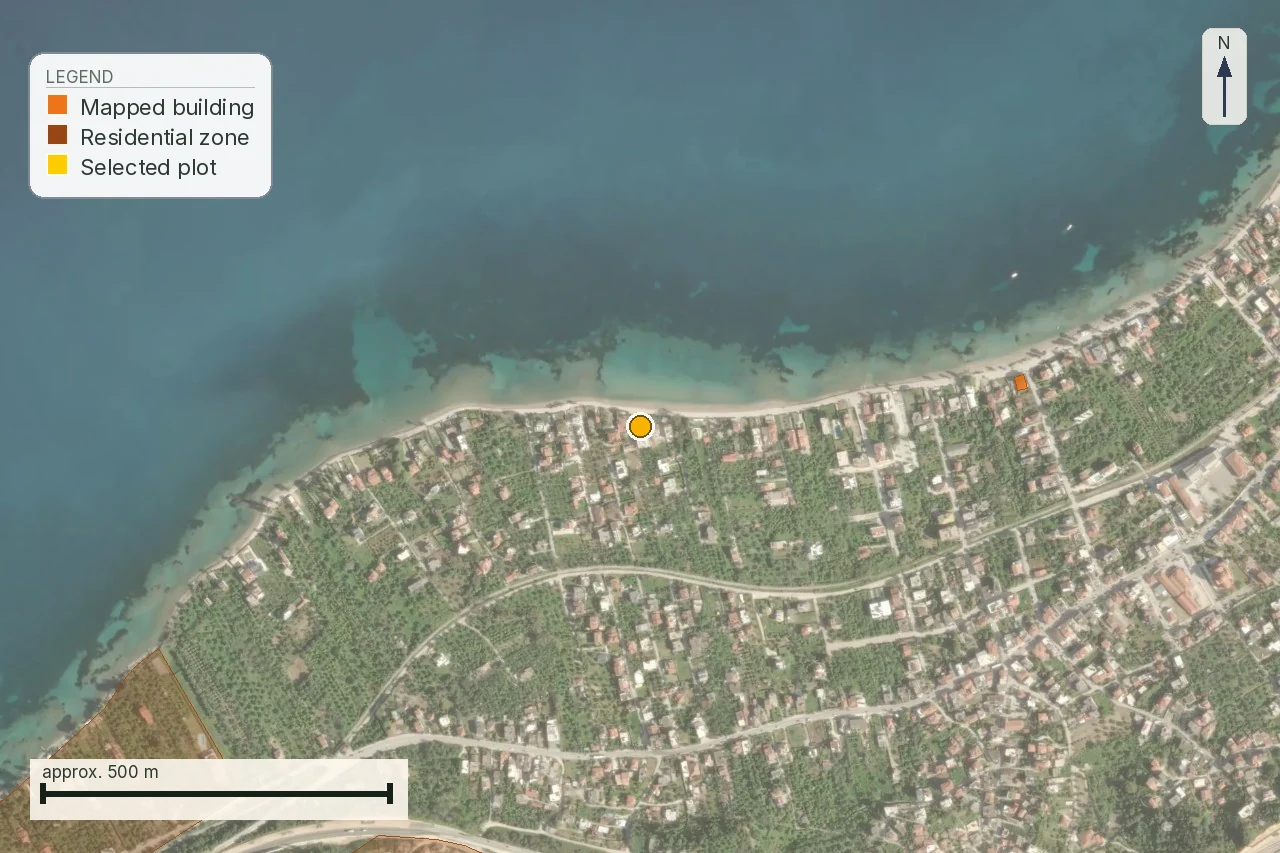
Check this on your own parcel
Pin the plot, confirm the KAEK, and every check in this guide is read against it and written up with its source and date. EUR 39 total · VAT included.