
Διαβάστε το άρθρο στα ελληνικά.
Buying land in Greece: the pre-purchase checklist, in the order the payments fall
On this page
Every pre-purchase check on a Greek plot, priced, and placed against the payment it has to be finished before: the free hour that answers most of it, the six questions that can still end a purchase, and the papers ν. 5306/2026 and the tax code oblige the notary to attach.
This guide is a preliminary screen for a cost or timing question, not legal, surveying, engineering or tax advice; read the full scope and limits before relying on it.
Buyers usually ask what to check on a Greek plot. The question that costs them money is when. There are three payment moments here, and the middle one, a notarial προσύμφωνο with its deposit, is the point after which walking away for a reason the pre-contract does not recognise costs a buyer the deposit. The list of things that have to be settled by then is shorter than most buyers expect, and most of it can be answered for nothing in an afternoon.
Three moments, and what leaving costs at each
An offer costs nothing. Some agents ask for a holding sum against taking the plot off the market. That paper, signed in an office and never before a notary, can bind on whatever it says about itself, an agency fee or a refund date, and it still cannot make the seller transfer the plot, because the promise to transfer land carries a form requirement of its own. The Civil Code in force is the text republished by π.δ. 456/1984 (ΦΕΚ Α΄ 164/24.10.1984), and the article numbers below are that text's. Άρθρο 166 ΑΚ puts a pre-contract under the same form requirement as the contract it promises: «η σύμβαση με την οποία τα μέρη ανέλαβαν την υποχρέωση να συνάψουν ορισμένη σύμβαση (προσύμφωνο) υπόκειται στον τύπο που ο νόμος ορίζει για τη σύμβαση που πρέπει να συναφθεί». For land, that form is notarial: άρθρο 1033 ΑΚ requires the transfer agreement to be made «με συμβολαιογραφικό έγγραφο» and registered, and άρθρο 369 ΑΚ says the same of any contract creating or moving a right in rem over immovable property. Greek practitioners read the two together and conclude that a pre-contract for land is void unless a notary drew it. That reading belongs to the profession; no single article carries the sentence, and no Άρειος Πάγος decision was opened for this page. It is nonetheless what every practitioner source consulted says.
The practical consequence is worth more than the doctrine, and it is narrower than English-language material usually makes it. Άρθρο 904 ΑΚ obliges anyone who «έγινε πλουσιότερος χωρίς νόμιμη αιτία» to give the benefit back, so the claim depends on there being no legal cause for the payment. A holding paper that validly fixes an agency fee, or a date on which the sum returns, supplies that cause for what it covers; the money is then claimed on the paper's own terms. Άρθρο 904 reaches what the paper leaves unexplained: a sum taken for a sale the seller never agreed to, or one kept past the refund date the paper itself set. Either route means asking for the money, then suing for it, in a foreign language and a foreign court. Treat a holding sum as money you may spend months getting back.
The second moment is the one this article exists for. A notarial προσύμφωνο with an αρραβώνας is where a Greek purchase stops being reversible on the buyer's own terms: the cost of being wrong moves from a few hundred euro of professional fees to a five-figure loss. Every check that could end the purchase belongs before it, or inside it as a written condition.
The size of the deposit is negotiable and no provision fixes it. ΑΚ 402 and 403, which decide what happens to the money, say nothing about how much of it there should be. Greek law firms writing for buyers put the customary figure at five to ten per cent of the agreed price and describe it as negotiable, «διαπραγματεύσιμο και συνήθως ανέρχεται στο 5-10% της συμφωνημένης τιμής πώλησης του ακινήτου» (lawsupport.gr, June 2023); ten per cent is the single figure most often named (bouraslaw.gr, April 2026). Both are market reporting, so treat the range as what to expect at the table and not as a rule you have to meet.
The third moment is the συμβόλαιο. Each of the three figures this page quotes for it has a provision behind it. Άρθρο 27 ν. 5219/2025 (ΦΕΚ Α΄ 130/18.7.2025), the transfer-tax article of the property-tax code, sets the tax at «τρία τοις εκατό (3%)» of the taxable value, and the same article adds a «πρόσθετος φόρος τρία τοις εκατό (3%) υπέρ των Δήμων» calculated on the tax itself. Three per cent multiplied by 1,03 gives the 3,09% everyone quotes, and it falls on the greater of the price and the αντικειμενική αξία. The registry's own charges are in άρθρο 3 of απόφ. 2/12.1.2026 (ΦΕΚ Β΄ 64/13.1.2026), read in the gazette sheet itself. Παρ. 4 α΄ sets an «αναλογικό τέλος ίσο με ποσοστό πέντε χιλιοστά (5‰) επί της αξίας του ακινήτου» for a sale. Παρ. 4 δ΄ raises that by «ενός χιλιοστού (1‰)» for entries made in the cadastral book of άρθρο 10 ν. 2664/1998, which is why a cadastred area costs 6‰ and an area still on the old books 5‰. The fixed part is 3 € under παρ. 3 plus 20 € under παρ. 4 γ΄, the 23 € on the figure above. The notary's proportional fee, the ΦΠΑ on it and the reduced rates for διανομή and compulsory exchange are worked through in the guide to the φόρος μεταβίβασης and are not repeated here.
What actually makes a deposit forfeit
English-language advice about Greek deposits is usually stated as a rule about walking away. The Civil Code states it as a rule about fault. Άρθρο 403 ΑΚ, headed «Τύχη του αρραβώνα», is one sentence long: «Ο υπαίτιος για τη μη εκτέλεση της σύμβασης χάνει τον αρραβώνα που έδωσε ή αποδίδει διπλάσιο αυτόν που έλαβε.» The operative word is υπαίτιος, at fault, and fault has to be established; it does not follow from the sale simply having failed. A seller at fault for that failure returns double what was taken, and a seller usually is where the title is unclean because of something in their own hands or their own family's chain. Where the failure is attributable to neither side, the article does not bite at all and the fourth card below is the one that governs. A buyer who abandons a purchase for no reason attributable to the seller loses the deposit. A buyer whose written condition failed is normally in neither category, and normally is the right word: the pre-contract can allocate the risk of a failed condition to one side expressly, and if it does, what it says is what happens.
The second sentence of the same article is the one sellers' lawyers know and buyers do not: «Σε περίπτωση αμφιβολίας δεν αποκλείεται υποχρέωση για περαιτέρω αποζημίωση, που μειώνεται όμως κατά το ποσό του αρραβώνα.» Losing the deposit is a floor on the exposure and not a ceiling. Άρθρο 402 ΑΚ supplies the default reading of what the money is for: «για την κάλυψη της ζημίας από τη μη εκτέλεση της σύμβασης». That article opens with the qualifier «εφόσον δεν ορίστηκε τίποτε άλλο», so the default is dispositive and anything the pre-contract states about the deposit displaces it. It is the reason to read the draft clause by clause instead of trusting the Code to protect you.
A paper headed ποινική ρήτρα is a different instrument altogether, governed by άρθρα 404 and 405 ΑΚ, and it can sit alongside a deposit or replace it. Ask which of the two your draft names before you read the number attached to it. Ask also what the pre-contract says about specific performance: a Greek court can order the seller to declare the will they promised, and άρθρο 949 ΚΠολΔ provides that the declaration «θεωρείται ότι έγινε μόλις η απόφαση γίνει τελεσίδικη», or from the moment the buyer's own performance is made where the judgment was conditioned on it. That is the remedy a buyer buys with a notarial pre-contract and does not have with a private one.
Two practical points sit behind the deposit and are usually left out of English-language material. A προσύμφωνο is not normally registered, so the plot stays in the seller's Ε9 until the deed. What does go into the cadastral records is listed in άρθρο 12 παρ. 1 ν. 2664/1998, opened for this revision at taxheaven.gr on 2 August 2026: «Στα κτηματολογικά φύλλα καταχωρίζονται» the acts of ΑΚ 1192 «με τις οποίες συνιστάται, μετατίθεται ή καταργείται εμπράγματο δικαίωμα σε ακίνητο», and, at περ. εʹ, «τελεσίδικες δικαστικές αποφάσεις που περιέχουν καταδίκη σε δήλωση βουλήσεως». No paragraph of that article names a pre-contract. The proposition that one carrying an αυτοσύμβαση clause in the buyer's favour becomes registrable is kstlaw.gr's reading, and the same page attributes the tax treatment of that case to ΠΟΛ 1237/2014. Take it as a practitioner's position and ask the notary offering it to name the entry they intend to make. And the deposit must move through a bank. Άρθρο 3 ν. 5073/2023 (ΦΕΚ Α΄ 204/11.12.2023) names «τα προσύμφωνα» expressly, sets no lower threshold, and carries a fine of 10% of the price with a floor of 10.000 € and a ceiling of 500.000 €.
Writing a condition a notary can act on
Άρθρο 201 ΑΚ allows the effects of a legal act to hang on a future uncertain event, and says they arrive «μόλις συμβεί το γεγονός». Άρθρο 202 does the mirror image: an event that unwinds an act already in force, restoring the prior position automatically. Both are ordinary drafting tools in a Greek pre-contract and a Greek notary will write either one.
What defeats a buyer is not the absence of the tool but the wording. «Subject to the plot being buildable» is not a condition anyone can test: two people will read it differently on the day it matters. A condition that works names three things. First, the document: an όροι δόμησης certificate from the ΥΔΟΜ, a πιστοποιητικό from the forestry service, or a written answer on whether the road at the boundary is recognised. Second, the office that issues it. Third, a date by which it must be in hand, after which the deposit returns without argument.
Two further clauses earn their space. One requiring the seller to bear the cost of any document only they can obtain, which is most of them. And one dealing with what happens if a public office simply does not answer in time, because several of the offices in this article have statutory deadlines that are missed as a matter of routine.
The free hour, before you drive anywhere
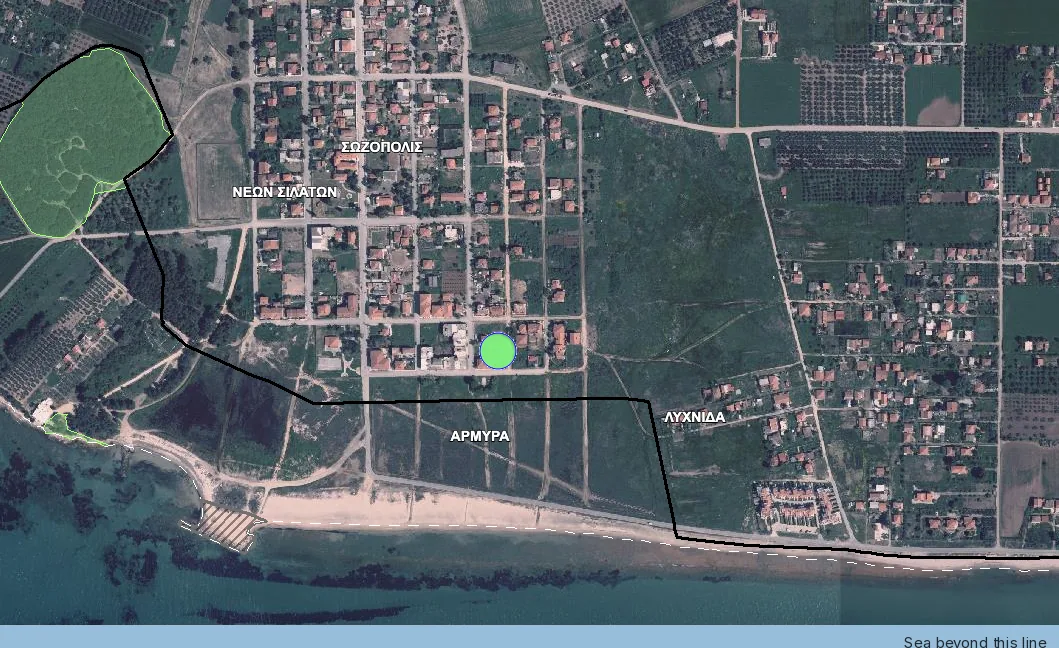
Four public viewers answer, at no cost and in about an hour, most of the questions that end purchases. Run them on the ΚΑΕΚ before you book a flight, then read the listing itself against what they returned.
- The δασικός χάρτης viewer, for the character code and whether a map governs the area at all.
- The planning layers of the Ενιαίος Ψηφιακός Χάρτης, for whether the land is εκτός σχεδίου and which act covers it.
- The cadastre viewer, to confirm the ΚΑΕΚ resolves to the shape the seller is describing.
- The ΥΠΕΝ flood layers and the coastline, for ζώνη πλημμύρας and αιγιαλός.
An estate agent's listing is not a fifth viewer, it is the thing the four viewers check. Read it literally once you have the four answers in hand. The vocabulary that hides problems is catalogued in the guide to χρήσεις γης and the restriction stack behind them.
Record every blank layer as a reading: note which viewer you used, the date, and the exact wording it returned. The forest viewer distinguishes an area with no forest character from an area no posted map covers yet, and only the first of those is an answer a buyer can rely on.
The shorter list: what has to be finished before the deposit
Buyers routinely try to complete a full due diligence before making an offer, which wastes money on plots they will not buy, or postpone all of it to the notary's desk, which wastes the deposit. The dividing line is whether the answer can end the purchase. Six questions can.
- Frontage. Whether the plot has πρόσωπο onto a recognised public road. Nothing on a map settles this; the ΥΔΟΜ and the title chain do.
- Qualification and the right to build. Whether the plot is άρτιο and οικοδομήσιμο, which are two separate tests and are failed separately.
- Forest character. The code, and the ratification stage behind it, because the stage decides what the code is worth.
- The shore, the stream and the dig. Αιγιαλός, ρέμα and any archaeological zone, each of which can take the buildable ground out of the middle of a plot that passes every other test.
- Title. The chain, the burdens, whether the seller owns the whole of it, and whether a τοπογραφικό διάγραμμα exists that matches the cadastral shape.
- Permission, if you need it. Buyers without EU or EFTA citizenship need the acquisition restriction lifted in the designated παραμεθόριες περιοχές before signing. The prohibition is άρθρο 25 παρ. 1 ν. 1892/1990 (ΦΕΚ Α΄ 101/31.7.1990), the lifting route and the committee are in άρθρο 26, and άρθρο 30 of the same law fixes what happens without a decision: «Δικαιοπραξίες που συνάπτονται κατά παράβαση των διατάξεων του νόμου αυτού είναι απολύτως άκυρες», with imprisonment of up to a year and a fine for the notary and the parties. The delay is the seller's problem too, which is worth saying out loud when you ask them to start it early.
Where a building stands on the land, add a seventh: whether any part of it is an αυθαίρετο and what settling it would cost. That question is answered from the engineer's file, and no map layer touches it.
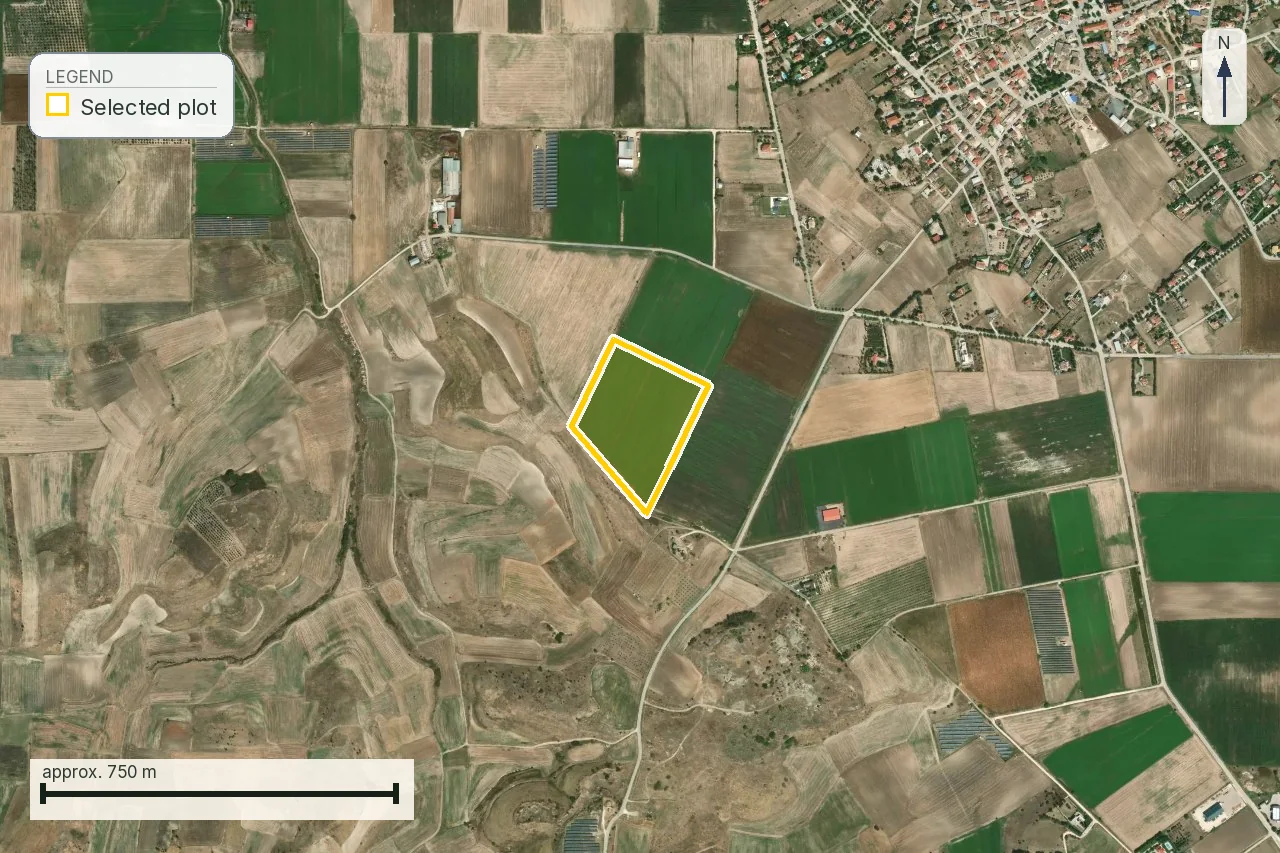
Connection costs, the fine detail of setbacks, whether the neighbour's licence for a wind farm is live: those change the price and not the decision, and they can be settled between the pre-contract and the deed. The building envelope does not automatically belong with them. Whether the plot may be built on at all is question two above and closes before the deposit; how much floor area it yields belongs there too when you are buying for a particular house, because a plot that gives 186 m² where the plan needed 300 has failed you as completely as one with no frontage. Where the programme is still open, the coefficients can wait.
A borehole or well needs a certificate the four viewers do not check
If the listing or the seller mentions a γεώτρηση (borehole), πηγάδι (well) or any other water abstraction point on the plot, add a check none of the four free viewers above cover. Άρθρο 9 παρ. 2 της ΚΥΑ οικ. 145026/2014 (ΦΕΚ Β΄ 31/14.1.2014), in the 2014 text, requires the notary's file to carry either the point's registration certificate in the Εθνικό Μητρώο Σημείων Υδροληψίας (ΕΜΣΥ), the national register of water points, or its code printed on the τοπογραφικό διάγραμμα, unless the code already appears on the water-use permit decision, which then covers the same requirement on its own. The rule reaches a sale, a gift, a parental grant, an inheritance and any right created over land carrying a water point. The circular that states it, Σ.Ε.Σ.Σ.Ε. 9η/17.1.2014, was issued by the Συντονιστική Επιτροπή Συμβολαιογραφικών Συλλόγων Ελλάδος, the national coordinating committee of the notarial bars; the Thessaloniki bar only publishes the retrievable copy, and did not issue it. Άρθρο 9 has since been amended by ΦΕΚ Β΄ 1212/10.7.2015, so treat the rule above as the 2014 text and ask your own lawyer for the wording now in force.
Without one of those two, the notary has nothing to sign against and the deed does not proceed. The Annex I EMSY registration application goes through the municipality, which only receives it; the Διεύθυνση Υδάτων of the Αποκεντρωμένη Διοίκηση for the region issues the certificate. It is a different office from the ΥΔΟΜ that answers most of the rest of this page. Ask there with the ΚΑΕΚ before you agree a price on a plot the listing says has its own water. Neither a fee nor a turnaround time for the certificate was found, and "no borehole registered" is itself an answer, as long as you record when you asked.
What each check costs, and how long it takes
Two rows in that table deserve a sentence each. The registry fees changed on 13 January 2026 and most English-language guides still print the 0,475% figure, which no instrument was found to support. And the forest objection fee was halved in 2021; a page printing 1.400 € for the top band is quoting the 2017 scale.
The βεβαίωση μη οφειλής ΤΑΠ belongs in the free band and is regularly forgotten. It is issued by the δήμος, costs nothing, takes ten days, and the deed cannot be signed without it. Asking the seller for it early is also a cheap test of whether they have their papers in order.
No tariff was located for the ΥΔΟΜ's written statement of building terms. What the statute does fix is the clock: άρθρο 324 παρ. 2 περ. βʹ ν. 5306/2026 requires it «εντός δέκα (10) ημερών από την υποβολή της σχετικής αίτησης», and requires the office to check the topographic diagram while it is at it.
The papers the notary cannot proceed without
The two-month rule catches more purchases than any other line in that figure. Άρθρο 368 παρ. 6 ν. 5306/2026 reads «Οι ανωτέρω βεβαιώσεις των μηχανικών έχουν ισχύ δύο (2) μηνών από την υπογραφή τους». A purchase that slips by a month because a mortgage took longer than expected pays the engineer twice. The same article, at παρ. 11 περ. αʹ, puts imprisonment of at least six months and a fine of 30.000 to 100.000 € on an inaccurate certificate, which is the reason engineers ask for time and documents before they sign one.
One line in that figure carries a citation this page could not give until now. The Πιστοποιητικό ΕΝΦΙΑ is imposed by άρθρο 60 παρ. 1 ν. 5104/2024 (ΦΕΚ Α΄ 58/19.4.2024), in the Κώδικας Φορολογικής Διαδικασίας, which is why guides hunting for it in the property-tax code come back empty-handed. It certifies that the property appeared in the owner's ΕΝΦΙΑ declaration «τα πέντε (5) προηγούμενα της μεταβίβασης έτη», and παρ. 2 makes the registrar refuse a deed that does not attach it.
A lawyer is optional. Compulsory attendance was abolished by ν. 4093/2012, ΦΕΚ Αʹ 222/12.11.2012, παράγραφος ΙΓ, which provides «Από 1.1.2014 η παράσταση δικηγόρου … είναι προαιρετική για όλα τα συμβαλλόμενα μέρη». Bar associations have asked for its return and it has not returned. The notary is a public officer who serves both sides, which means nobody in the room is checking the title chain on the buyer's behalf unless the buyer engages someone. Fees are freely agreed; the 1–2% figures that circulate are market reporting, mirror the old γραμμάτιο προείσπραξης reference tiers, and are no tariff.
What expires, and what keeps its value
A check that came back clean has a shelf life, and the lengths differ enough to matter to the order of work.
- The βεβαίωση μηχανικού lives two months, and that one is statutory: άρθρο 368 παρ. 6 ν. 5306/2026, quoted above. Obtain it last.
- The ΤΑΠ certificate is good to 31 December of the year it was issued, so one taken out in November is a short-lived document. Άρθρο 24 παρ. 18 ν. 2130/1993 requires the certificate and says nothing about how long it lasts; the 31 December limit and the free issue are published by the state in the service description on mitos.gov.gr, read 2 August 2026, and we found them in no statute.
- The ΥΔΟΜ statement of terms travels with the engineer's declaration that nothing has changed. Άρθρο 324 παρ. 2 περ. βʹ fixes the ten days for issuing it and gives it no life at all, so treat this one as practice: nothing printed on the sheet expires, and the declaration behind it is what goes stale.
- A topographic diagram has no expiry in any provision we located. What retires it is άρθρο 368 παρ. 4 ν. 5306/2026, which wants a sheet drawn to the specifications in force and tied to the state coordinate system, or a change in the boundaries. Separately, ν. 4409/2016 (ΦΕΚ Α΄ 136/28.7.2016), άρθρο 40 παρ. 1, has the deed carry the electronic filing certificate «με ποινή ακυρότητάς της»; that the filing duty bites on diagrams drawn from 16 July 2018 is ΕΚΧΑ guidance as reported by taxheaven.gr, and it is the date every notary works to.
- A forest map answer changes with the ratification stage, and an area outside any posted map today can be posted next year.
- An answer on nearby licences for extraction, wind or solar is the shortest-lived of all, because a licence granted six months after a report is an ordinary event.
Re-run the short ones in the fortnight before signing. That is one afternoon and it is the cheapest insurance in the whole sequence.
Where our own report sits in this order
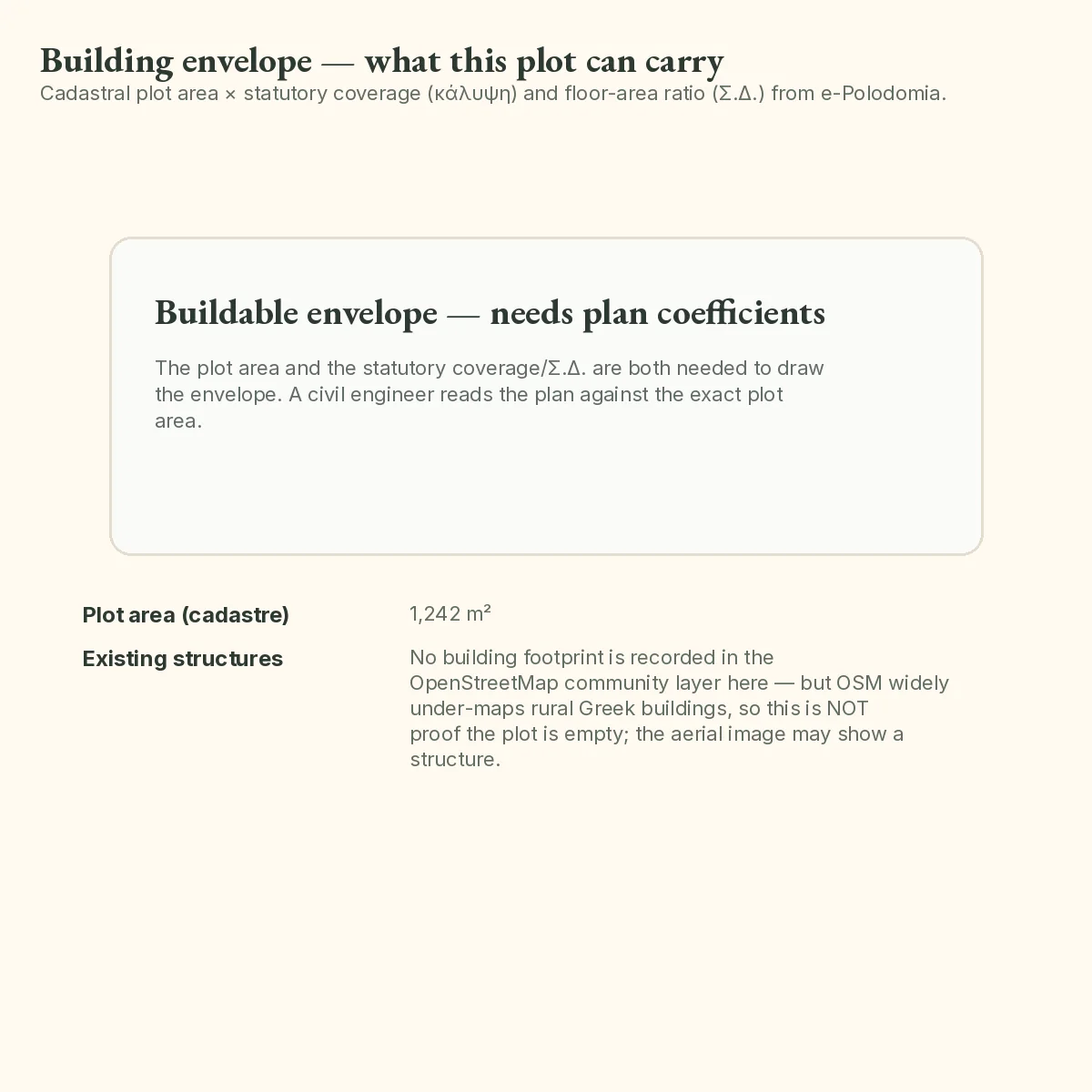
LandCheck sells a 39 € report and it belongs in exactly one place on the ladder: at the top of it, before anything is paid to a professional. What it does is read the public layers against one ΚΑΕΚ, date every answer, name the source, and say which of the expensive checks this particular plot actually needs. On a plot with a clean forest code, frontage onto a village street and no coast within a kilometre, that is a short list. On the Thessaly parcel below it is one item, and it is the item that decides the purchase.
Its limits deserve the same plainness. It issues no βεβαίωση, and no office treats it as one. Whether a track at the boundary is a κοινόχρηστη οδός is settled in the title chain and the ΥΔΟΜ's records, so a map layer cannot answer it and neither can we. Title work stays with a lawyer, the diagram and the certificate with an engineer, a contested forest code with a forester. What the report supplies is the order in which you pay those three, and the evidence that a particular plot needs one of them at all.
One parcel, priced through the whole order
The Thessaly plot is the useful example precisely because nothing dramatic is wrong with it. The forest map is clean, the ground is flat and good, the area is fourteen times the out-of-plan minimum, and the price per στρέμμα looks like a bargain against anything coastal. The whole purchase turns on one question, frontage, which costs about a thousand euro and six weeks to answer. A buyer who pays the deposit before that answer arrives, and then walks when it comes back adverse, is the υπαίτιος party under ΑΚ 403 and loses the money, unless the προσύμφωνο named the ΥΔΟΜ document as a condition under ΑΚ 201.
When an answer comes back wrong after the money has moved
The route depends on which office got it wrong, and each route has its own clock. Against an act or an omission of the ΥΔΟΜ in the course of issuing a permit or a προέγκριση, the appeal is now άρθρο 459 παρ. 5 ν. 5306/2026 (ΦΕΚ Α΄ 88/8.6.2026) [formerly άρθρο 23 παρ. 1 ν. 4495/2017, ΦΕΚ Α΄ 167/3.11.2017, which the code carries forward paragraph by paragraph]. It goes to the regional planning council, the ΠΕ.ΣΥ.ΠΟ.Θ.Α., «εντός αποκλειστικής προθεσμίας τριάντα (30) ημερών» from service or from otherwise obtaining full knowledge of the act, and it is filed «με κατάθεση αυτής στο πρωτόκολλο της υπηρεσίας δόμησης, που εξέδωσε την προσβαλλόμενη πράξη», which then forwards it. Taking it to the council direct is the standard way to lose the deadline. Παρ. 6 makes a παράβολο of 50 € a condition of admissibility; the hearing is set within thirty days of the file arriving and the decision follows within thirty days of the hearing. After that comes an αίτηση ακυρώσεως under άρθρο 46 παρ. 1 π.δ. 18/1989, «μέσα σε προθεσμία εξήντα ημερών».
A βεβαίωση όρων δόμησης that issues but states the wrong terms has no special route in the code. What is left is the ordinary administrative one: apply to the same ΥΔΟΜ for ανάκληση and re-issue, naming the term you say is wrong and the plan provision it contradicts. The ten-day rule of άρθρο 324 παρ. 2 περ. βʹ runs again on that fresh application, and if nothing comes back at all, the general fifty-day rule of άρθρο 4 παρ. 1 ν. 2690/1999 (ΦΕΚ Α΄ 45/9.3.1999) turns the silence into a rejection you can act against. That last step is the standard administrative-procedure rule as practitioners state it; we have not read it in the gazette sheet itself.
A wrong cadastral entry has its own repair, the πρόδηλο σφάλμα route, with the serious reservation that first registrations which have finalised are outside it and have to go to court. A forest-map error has the αντίρρηση, whose exclusive windows have closed across the great majority of the country, so what usually remains there is the πρόδηλο σφάλμα or annulment in court. Both are described in their own articles and both are measured in months.
On the contract side the question stays the one άρθρο 403 ΑΚ asks: whose fault. A seller who warranted something that turns out to be untrue is the party at fault, which is the practical reason to have the warranty written into the προσύμφωνο instead of said on the telephone. Where part of the price has already been paid, what a written condition does is change what has to be proved: instead of arguing about fault, you produce a named document that did not arrive by a named date, and the consequence the pre-contract attached to that. The bank trail that άρθρο 3 ν. 5073/2023 makes compulsory does the smaller job of fixing how much moved and when. Neither obliges the seller to hand the money back on being asked. If they refuse, the claim runs its ordinary course, and the time it takes is the court's.
What to ask, and in what order
- Ask the seller for the ΚΑΕΚ and the title deed, and run the five free viewers yourself the same evening.
- Ask the seller for the τοπογραφικό διάγραμμα they already hold, along with its electronic filing code where the sheet is dated 16 July 2018 or later.
- Ask the ΥΔΟΜ in writing whether any road bounding the plot is recognised, and for the building terms in force at the property. Ten days by statute.
- Instruct an engineer for a current diagram and a written opinion on qualification and frontage, and a lawyer for the title chain and burdens. Both before any deposit.
- Have the notary draft the προσύμφωνο with every unresolved answer as a condition under άρθρο 201 ΑΚ, each naming a document, an office and a date.
- Pay the αρραβώνας by bank transfer, never in cash, whatever the amount.
- In the fortnight before the deed, refresh the βεβαίωση μηχανικού, the ΤΑΠ certificate and the licence layers, and confirm the ΕΝΦΙΑ certificate covers the five preceding years.
- Buying from abroad, arrange the πληρεξούσιο and the ΑΦΜ early; both take longer than the paperwork they enable.
The order above is the one that spends the least money on plots you will not buy. The only part of it that is genuinely inflexible is that the deposit at step six waits for the engineer and the lawyer at step four.
Common questions
Which checks must be finished before I pay a deposit on Greek land?
Six: frontage onto a recognised κοινόχρηστη οδός, whether the plot is άρτιο and οικοδομήσιμο, the forest character code and its ratification stage, αιγιαλός, ρέμα and archaeological zones, the title chain with its burdens, and, for a buyer without EU or EFTA citizenship, the border-area consent. Connection costs and the fine detail of setbacks only change the price and can wait until after the προσύμφωνο. The building envelope is not automatically in that class: if you are buying for a particular house, the floor area the plot yields belongs before the deposit as well.
Is a deposit on a Greek property refundable if I change my mind?
Άρθρο 403 ΑΚ asks who is υπαίτιος, at fault, and never who changed their mind. A buyer who simply reconsiders is the party at fault and loses the deposit. A buyer stopped by a condition written into the προσύμφωνο under άρθρο 201 ΑΚ is usually in neither class and gets the money back, unless the pre-contract puts the risk of that condition on them, which it is free to do. Read the draft before you sign it: what it says about the deposit displaces the Code's default.
Does a Greek pre-contract have to be signed in front of a notary?
For land, yes. Άρθρο 166 ΑΚ puts a προσύμφωνο under the form the law requires for the final contract, and άρθρο 1033 ΑΚ requires the transfer agreement to be made «με συμβολαιογραφικό έγγραφο» and registered. Greek practice reads the two together and treats a privately signed pre-contract for land as void; that reading belongs to the profession, and no single article carries the wording. Money paid on such a paper is recovered as unjust enrichment under άρθρο 904 ΑΚ, which means asking for it and then suing for it.
How do I make an offer conditional on the plot being buildable?
Not with the words «subject to the plot being buildable», which nobody can test. Άρθρο 201 ΑΚ lets the effects hang on a future uncertain event, so name the event precisely: the written βεβαίωση όρων δόμησης of the named ΥΔΟΜ, confirming frontage onto a recognised road, in hand by a stated date. The ΥΔΟΜ owes that document within ten days of the application under άρθρο 324 παρ. 2 περ. β΄ ν. 5306/2026. Add a clause for the case where the office does not answer at all.
What does it cost to check a Greek plot before deciding?
Nothing for the first hour: the δασικός χάρτης viewer, the planning layers of the Ενιαίος Ψηφιακός Χάρτης, the cadastre viewer and the ΥΠΕΝ flood layers are free, and the βεβαίωση μη οφειλής ΤΑΠ from the δήμος is free as well. Then tens of euro: a κτηματολογικό απόσπασμα is 9,50 €, the κτηματολογικό διάγραμμα 15 € and the κτηματογραφικό 33 €, under απόφ. 2/12.1.2026 (ΦΕΚ Β΄ 64/13.1.2026). Only after that does a plot earn a τοπογραφικό at 150 to 1.000 € and a title search at the lawyer's agreed fee.
Can I pay the deposit in cash?
No, and the prohibition names the pre-contract expressly: άρθρο 3 ν. 5073/2023 (ΦΕΚ Α΄ 204/11.12.2023) covers «τα προσύμφωνα» alongside the deed itself and sets no lower threshold, so it reaches every amount. Pay from a named account to a named account and keep the confirmation with the pre-contract.
Keep reading
Check this on your own parcel
Pin the plot, confirm the KAEK, and every check in this guide is read against it and written up with its source and date. EUR 39 total · VAT included.