
Pillar: Ground, hazard and utilities
Διαβάστε το άρθρο στα ελληνικά.
Utilities for a remote Greek property: electricity, water and internet
On this page
A pole, pipe or coverage cell is a clue. It is not a connection offer, a legal route or a delivery date.
This guide is a preliminary screen for a cost or timing question, not legal, surveying, engineering or tax advice; read the full scope and limits before relying on it.
Remote land is often advertised with one reassuring sentence: “electricity and water nearby”. That sentence can hide four separate questions. Is the feature real and current? Is it operated by the right provider? Can this property legally and technically connect? What will the route, works and time cost? The access guide matters here because a utility route across a neighbour’s land is not the same as a visible line on a map.
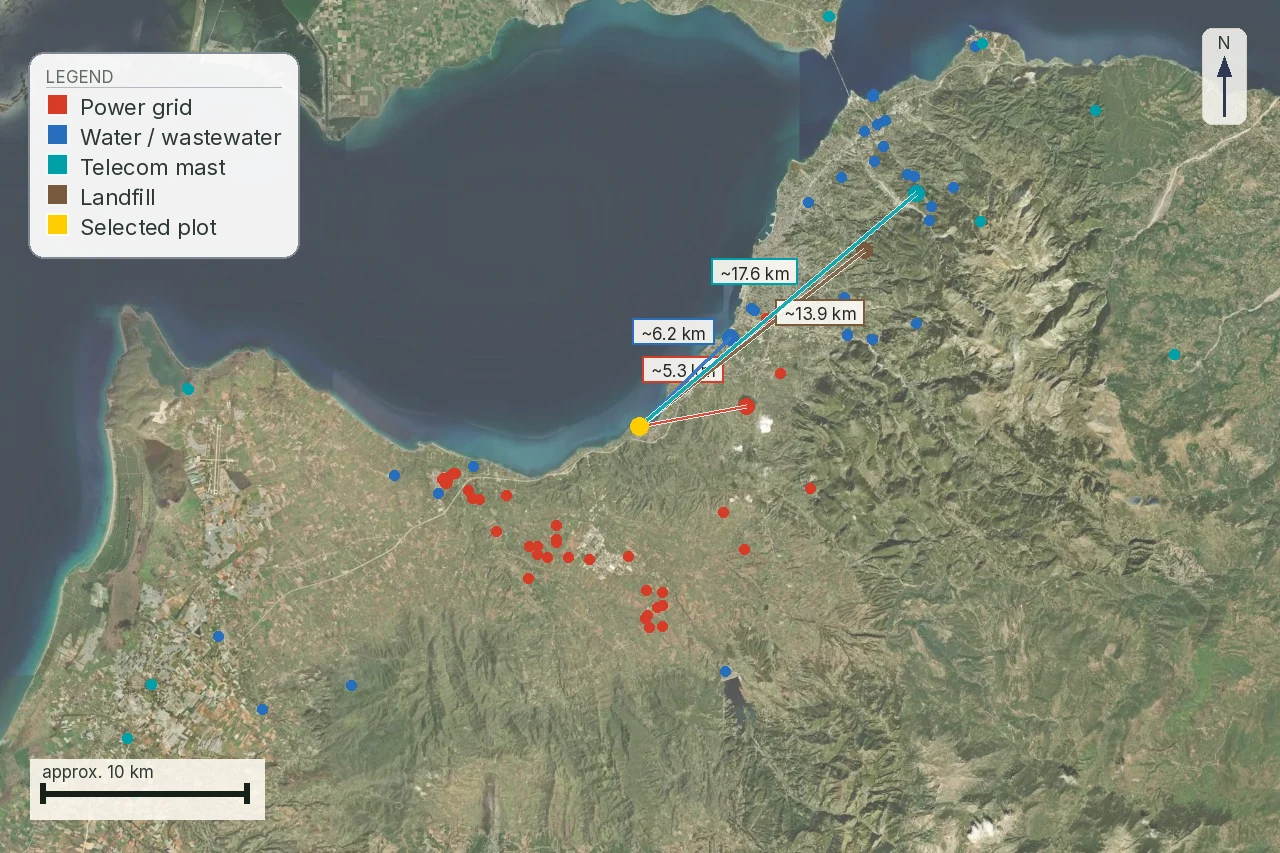
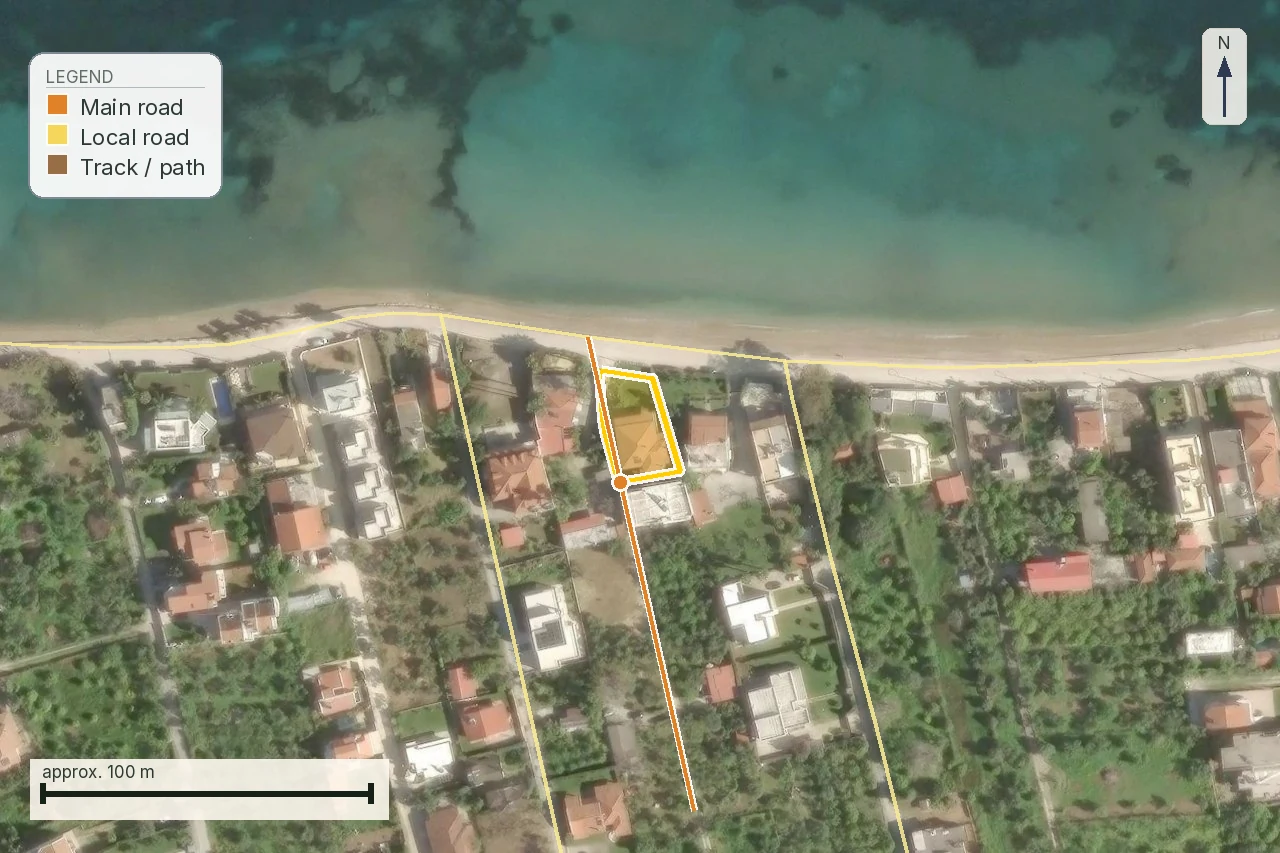
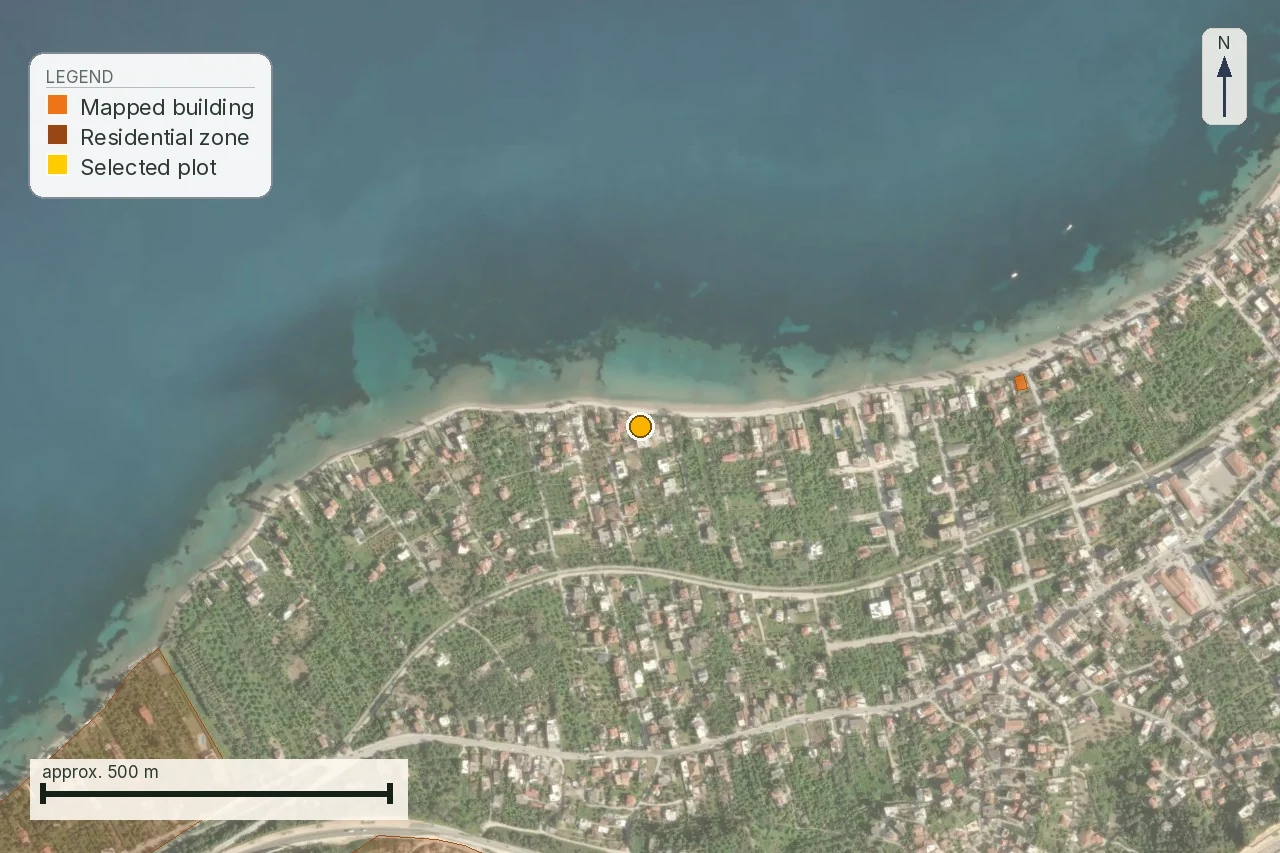
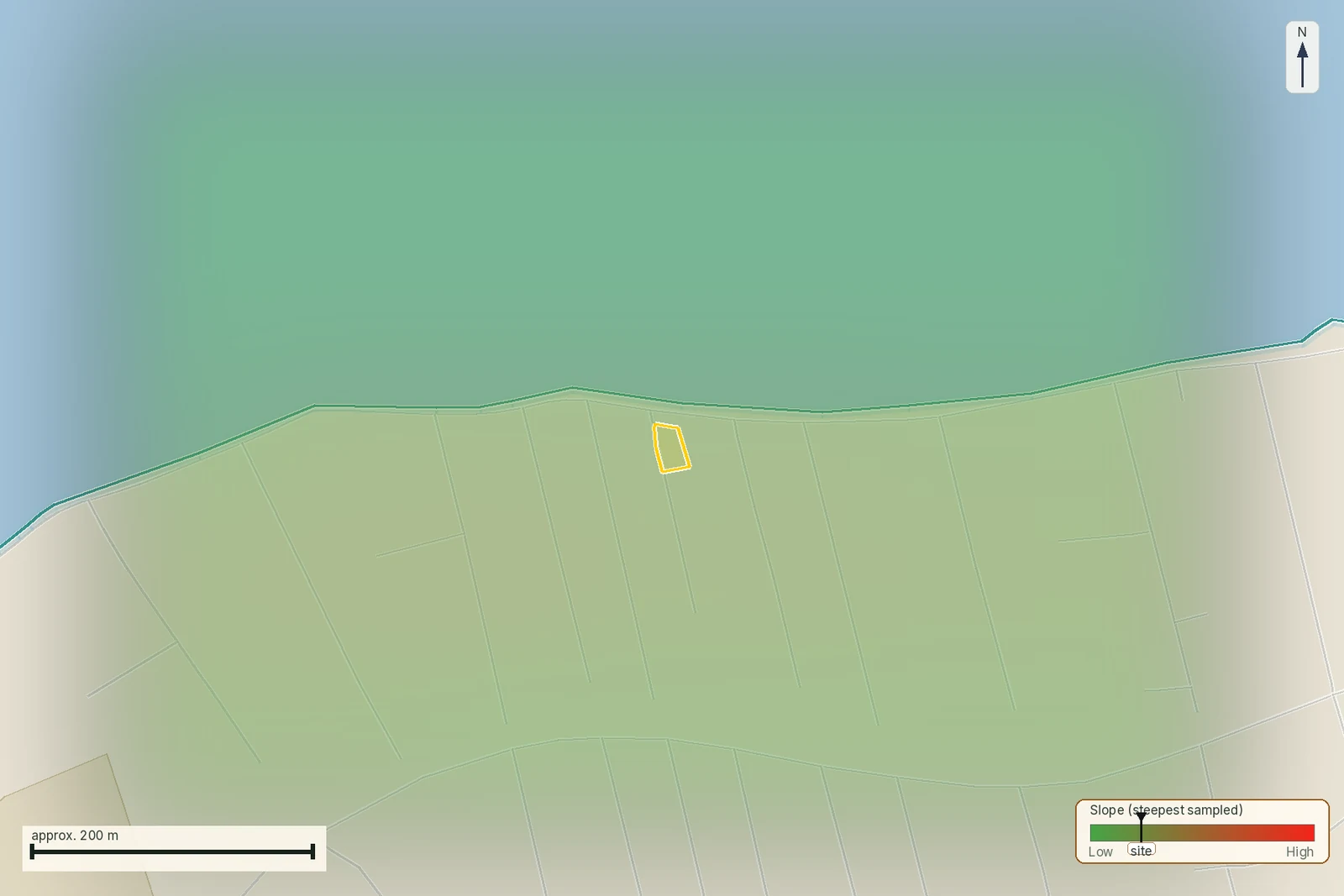
Worked parcel: For the Πόρος, Lefkada parcel, the measured area is 41,307 m² with mean slope 28.6%. The nearest mapped road is 10 m away, but it is a track. That distance does not establish frontage or a utility route, so the buyer still needs the operator’s answer and a professional check of any crossing or easement.
The safest workflow treats every service as a chain with a different owner. First identify the property and proposed building. Then name the operator or municipality, the requested use and the route. Next obtain a written answer or the formal application path. Cost and timing belong after that evidence exists. A preflight can organise the chain and show what appears nearby; it cannot skip the provider’s decision.
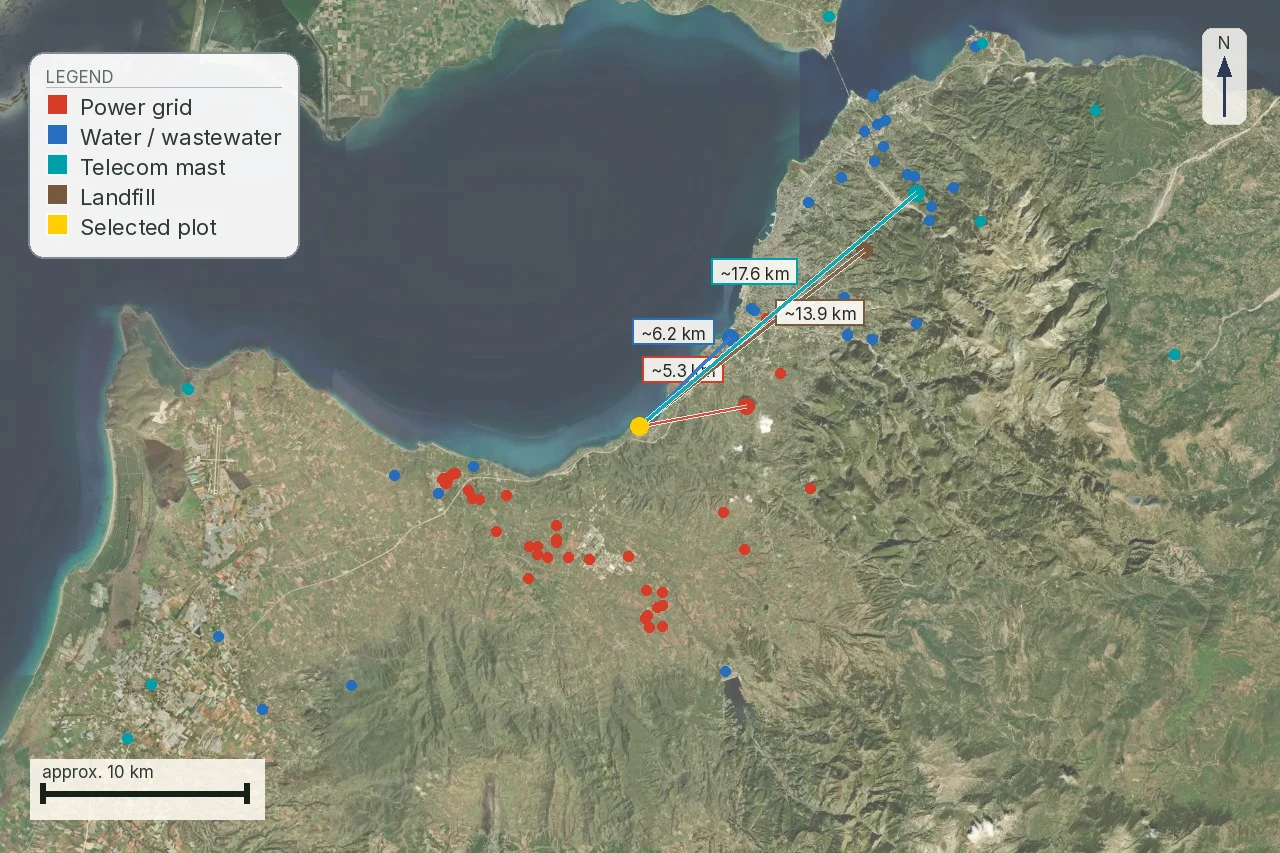
Electricity has the clearest official public procedure in this set. HEDNO describes a new-connection sequence: initial application and supporting documents, technical study and contribution offer, payment and contract, construction of the new supply, submission of activation documents, and activation. That sequence is the reason a map showing a pole or line can never be the final answer. A visible network feature is upstream context; the connection decision is made through the operator’s process for the exact request.
Why “near utilities” is not a connection result
Distance is only one variable. The route may cross a road, stream, protected area or private land. The network may lack capacity, require reinforcement or serve a different voltage or pressure class. The property may not have the documents or lawful building status needed for the requested supply. A remote house may also need internal works, a meter position, a pump, a wastewater solution or a telecommunications installation that sits outside the public network.
Even when the map is accurate, the buyer needs the meaning of the feature. A high-voltage line is not a low-voltage house connection. A water main is not a service pipe to the parcel. A fibre coverage polygon is not an appointment or a building-ready terminal. A road-side cabinet may serve another direction. The preflight should name the feature and stop before claiming access.
Use proximity as a reason to ask a precise question: “Can the operator confirm service to this exact address or parcel for the proposed use, and what documents and works are required?” The answer should be dated and saved. If the provider will only answer after a formal application, the report should say that the application is the next gate.
Electricity: follow the HEDNO sequence
HEDNO’s official new-connection page sets out a staged process. The applicant submits an initial request and supporting documents for a technical connection study. HEDNO studies the request, calculates the customer’s participation in the cost and prepares an offer. The applicant pays the connection cost and signs the agreement. The new supply is constructed. The applicant then submits the activation documents and the connection is activated.
This is useful buyer evidence because it identifies what a map cannot contain: the operator’s study, the offer, the construction scope and the activation conditions. The official page also refers to a connection certificate to utility networks issued through the TEE e-Permits system by an engineer for the customer’s choice, where required for the initial connection. The report must not simplify that into “electricity is available”. It should ask which stage has actually been reached.
For a vacant plot, ask whether the requested supply is for a construction site or a permanent building and which certificate and building documents apply. For an existing house, ask for the supply number, bills, meter status and any pending modification. A pole near the boundary cannot answer either question.
TAP: the certificate that travels with the meter
The Greek Τέλος Ακίνητης Περιουσίας (TAP) is a property charge associated with the electricity account in the situations described by the local authority. The municipality’s revenue service issues a certificate of no outstanding TAP debt. It is free, issued within five days from the electronic records already held by the municipality, and valid for one year from issue under paragraph 18(a) of article 24 of Law 2130/1993 as amended.
Without the certificate of no outstanding TAP debt, the notarial deed is void. Ask the municipality’s revenue service for the certificate before the deed and keep the issue date in the file. This is a deed-critical document, not evidence that an empty plot can connect to electricity.
The question of whether TAP is still collected through the electricity bill is not confirmed in 2026 by a legislative text on this page; it rests on journalistic reports. Ask the municipality directly before assuming the current collection mechanism.
Water and sewerage are provider questions
There is no single national answer to “water nearby”. A municipality, local water company, sewerage board or another competent body may control the service. EYDAP’s published network material shows why route and elevation matter: sewerage systems can use gravity, pumping stations and pressure pipes, and property connections are made through the competent body’s lateral. It describes practice in the EYDAP area; it does not establish service elsewhere in Greece.
For water, ask who issues the supply, whether the exact address is within the service area, where the connection point is, whether a meter exists, and whether a new extension or private route is required. For sewerage, ask whether the network is operational at the property, whether a legal connection exists, what certificate proves it, and what interim wastewater arrangement is lawful. The existing wastewater guide should be read alongside this page.
A borehole, tank or septic system is not a public network connection. It has its own permits, technical, environmental and maintenance questions. A report can say that no public connection evidence was found and list the document or authority to contact. It should not label an off-grid arrangement “ready” from a photograph or a listing.
Internet: coverage is not installation
The official HEMD broadband map shows fixed and mobile coverage across Greece and lets a user search by address. That makes it a useful first screen for a remote property, especially when a buyer is considering home working or a rental. But coverage maps are modelled or provider-reported service information. They do not prove that a technician can install at the building, that the route reaches a private gate, that a building has internal cabling, or that the advertised speed will be achieved at every time.
Record the technology shown: fibre, copper, fixed wireless or mobile. Record the address used and the date. Ask the provider to confirm availability, installation charge, equipment, contract, expected speed and whether the service is fixed to the exact building. If the property is only a field, the address may not resolve to the future building at all.
Mobile coverage has a different uncertainty. Terrain, building materials, antenna load and network conditions can affect the indoor result. A map cell is not a measurement from the room where the buyer will work. Treat it as a reason to test with the intended carrier or ask for a provider statement.
How to use OSM and other visible map layers
OpenStreetMap can help show visible roads, buildings, power features, water features and amenities. Its official attribution guide explains that the data are under ODbL and require credit, with share-alike obligations for adapted databases. That is a licensing rule and a data-quality warning. OSM does not prove that a road is legally public, that a utility is live, or that a line is operated by the provider the buyer needs.
Keep OSM-derived context visibly separate from official operator answers. A map legend can say “visible feature in OSM, accessed date” and the limitation can say “not proof of legal access or connection”. Do not draw a colourful route from a pole to the parcel and make it look like an approved design. If a route is illustrative, label it illustrative and do not use an official-looking network symbology.
For paid reports, store the source URL, attribution text and date with the visual. Do not copy an unlicensed utility provider map into a PDF simply because it is visible in a web browser. When rights are unclear, use an authored process diagram and link the buyer to the official service.
Documents that move a utility question forward
The document pack depends on the utility, but a buyer can ask for a property address or parcel reference, current title and survey, building permit or certificate where relevant, existing supply number and bills, operator correspondence, connection offer, payment proof, connection agreement, meter information and any easement or road-consent document for a private route. Keep seller claims in a separate column from operator documents.
For a new electricity supply, the HEDNO process makes the technical study and offer central. For sewerage, ask for the competent body’s certificate or written confirmation of legal connection. For broadband, keep the address check and provider availability response. For water, ask the local operator what application and meter evidence are required. A generic invoice proves past service to a named building. It says nothing about capacity for a new remote extension.
If the seller only provides a photograph of a pole, pipe or router, record “visual claim only”. It may be useful, but it is not a network record. If a private easement is required, ask the lawyer to inspect its wording, registration and route. A physical route can be visible and still lack the legal right to install or maintain a service.
| EVIDENCE | SUPPORTS | DOES NOT PROVE |
|---|---|---|
| Map feature | Nearby context and a question | Capacity or right |
| Existing bill | Past service to a named supply | New service to the parcel |
| Connection offer | Operator’s stated route/cost stage | Completed activation |
| Provider response | Availability on stated assumptions | Permanent performance |
Cost and time: ask for a provider answer
Do not estimate connection cost from metres alone. The route, network class, crossings, land rights, design, contribution, construction and internal works may all matter. HEDNO explicitly describes a technical study and contribution offer, which is the point at which an operator-specific amount becomes meaningful. Before that, a report may show “cost not determined” and explain what document would determine it.
Time has the same discipline. A seller’s “it will take two weeks” is not the operator’s committed stage. Ask whether the application is submitted, whether the technical study is complete, whether the offer is accepted and paid, whether works are scheduled, and whether activation documents remain. A property that has a paid offer is not identical to one with an active meter.
Water, sewerage and broadband may have their own local clocks and capital works. The report should not copy HEDNO stages into those systems. It should name the local provider and record the answer it actually gives. If no provider answer exists, the missing-data checklist should say who must be contacted.
Off-grid is a separate design and legal file
Remote properties often shift from “connection” to “alternative system”. Solar generation, batteries, tanks, boreholes, septic systems, satellite internet and generators can be sensible solutions, but they introduce their own design, permits, maintenance, access and operating costs. They are not a way to mark the public network as available.
For wastewater, ask the engineer and local authority which arrangement is lawful for the intended building and site. For water, ask about source, quality, storage and seasonal reliability. For power, ask about load, backup, approvals and fire or safety constraints. For connectivity, ask about line of sight, equipment and service terms. A listing’s “off-grid” label describes a design brief. The finished utility solution still needs evidence.
Separate capital from operating cost. A long private trench, pump or battery may be an upfront project. Emptying, fuel, maintenance and replacement are recurring. The buyer’s decision needs both, even if the public map is silent.
Decision gates before a deposit
Gate one is identity: do the address, survey, title and intended building describe the same place? Gate two is provider: who owns or operates the relevant service? Gate three is stage: is the evidence a map signal, an application, a study, an offer, construction or activation? Gate four is route: does installation need an easement, crossing, excavation or private works? Gate five is cost and time: which amount and date are written by the provider?
Pause if the seller relies on “nearby” without a provider, if an existing bill refers to a different building, if a broadband map is treated as an installation order, if the route crosses land with no legal right, or if the proposed use depends on the connection and no written next step exists. This pause does not decide that connection is impossible. It protects the buyer until the question is testable.
Proceed to a local application or professional review when the property identity is coherent and the buyer is ready to supply the required documents. Put decision-critical utility assumptions into the legal workflow. The purchase checklist should carry the utility gate alongside title, road and buildability gates.
What the map or portal does not confirm
A visible electricity line does not confirm capacity, legal connection, a meter, cost, works or activation. A water pipe does not confirm service area, pressure, meter, water quality or a private route. A sewer map does not confirm a legal lateral or operational treatment capacity. A broadband polygon does not confirm installation, indoor signal, speed or contract.
No utility evidence confirms title, building legality, planning permission, road rights, easement, construction budget or a safe purchase. A provider website is not necessarily a certificate. A screenshot is not a signed offer. The source date matters, but it does not convert a public display into a property-specific commitment.
If a source fails, write the failure precisely: “operator result not retrieved”, “address not recognised”, “coverage shown but installation not confirmed”, or “no public sewer connection evidence found”. Never collapse these states into “no utility” or “utility available”.
Missing-data checklist
- Exact address, survey boundary and intended building/use.
- Named electricity, water, sewerage and internet operator.
- Map source, layer, technology, date and attribution.
- Existing supply number, meter, bills or service certificate where relevant.
- HEDNO application, technical study, offer, agreement or activation stage.
- Water/sewerage authority answer and legal-connection evidence.
- Provider response for broadband installation at the exact building.
- Route, easement, crossing, excavation and private-maintenance requirements.
- Capital and recurring cost assumptions, each labelled as confirmed or unknown.
Questions for providers and professionals
- Which body is responsible for this exact address and service?
- Is the visible feature the correct network type for the proposed use?
- What is the next formal application and which documents are required?
- Has a technical study or written offer been issued?
- Does the route cross public or private land, and what right is needed?
- What costs are confirmed and which are only estimates?
- For water and wastewater, what certificate proves legal connection?
- For broadband, does the answer refer to the future building? A nearby address cannot answer that.
- Which engineer or lawyer must review the route and easement?
Buyer workflow from listing to decision
At listing stage: save the claim and mark every “near utilities” sentence as unverified. At map stage: identify visible features and official coverage, with source and date. At document stage: collect supply numbers, bills, operator correspondence, surveys and route rights. At professional stage: give the engineer and lawyer the same boundary and intended use.
Before deposit: require a written next step for every utility that the project needs. That may be an operator application, technical study, local water answer, wastewater design or broadband confirmation. Before deed: refresh the answer if the building, route, provider or intended use changed. A remote property is not ready because a line was visible once.
The right conclusion is conditional: public evidence suggests a provider question, but the connection is confirmed only at the stage the provider has written. That sentence protects the buyer and gives the seller a fair route to prove the claim.
| HANDOFF | ASK FOR | OWNER |
|---|---|---|
| Electricity | HEDNO stage and written offer | Operator/engineer |
| Water | Service area and connection answer | Water body |
| Wastewater | Legal connection or lawful design | Authority/engineer |
| Internet | Exact-building availability | Provider |
Proximity is useful only once it turns into a specific request. A pole on the map tells the buyer which provider to ask. A coverage cell tells them which operator to call. A pipe tells them which connection certificate to request. The map feature opens a question; it does not supply the provider’s answer.
Keep the original screenshot only when the licence, the exact attribution and the redaction are clean. Otherwise use an authored diagram and a link to the official service. An honest diagram beats a map that looks official but cannot legally be redistributed.
The same principle repeats for every utility, under a different provider each time: HEDNO for power, the municipality or company for water and sewerage, the operator for broadband. Carrying one utility’s stage over to another is a mistake. That each follows its own process is itself part of the risk.
A report that leaves cost as “not determined” can still be correct. The mistake is filling in an arbitrary figure to look complete. State what is needed to produce the offer, and who the application must be sent to.
Common questions
Does a nearby power line prove I can connect?
No. A nearby line is only a map signal. Ask HEDNO for the property's new-connection stage and written study, offer or activation evidence; the route requires the operator's process.
What is the first electricity document to request?
Ask which HEDNO stage has been reached, then request the matching application, technical study, offer or activation evidence. Keep the document with its access date.
Does an existing bill prove a new building can connect?
No. An existing bill shows past service for a particular supply and property context. A new connection or upgrade needs its own operator process, so request the current stage.
Does a water pipe near the plot guarantee water?
No. A nearby pipe is only a clue. Ask the local water body to confirm service area, connection point, route, meter and requirements for the exact address before treating water as available.
Does a sewer map prove legal connection?
No. Ask the competent body for evidence of a legal connection, and ask an engineer to set out the lawful wastewater solution for this property.
Does HEMD broadband coverage guarantee fibre at the house?
No. HEMD is a coverage screen, not an installation appointment. Ask the provider to confirm the technology and installation availability at the exact building.
Can OSM prove legal utility access?
No. OSM supplies visible geographic context with attribution, but it does not prove legal rights, network capacity or live service. Confirm access and service with the competent provider.
When should utility assumptions be written into the purchase process?
Write utility assumptions into the purchase process before a deposit when the project depends on them. Your lawyer should specify the required written answer and what follows if it is not obtained.
Keep reading
Legal road access in Greece: what πρόσωπο σε κοινόχρηστη οδό means, and how a road becomes public
Septic tank or sewer in Greece: the wastewater question before buying
Buying land in Greece: the pre-purchase checklist, in the order the payments fall
Building on a slope in Greece: read the terrain before the view
Check this on your own parcel
Pin the plot, confirm the KAEK, and every check in this guide is read against it and written up with its source and date. EUR 39 total · VAT included.